
If you’re running a business in Juneau, you already feel it.
Revenue comes in… but what stays with you never feels proportional.
You look at your numbers at year-end and wonder where it all went.
Because in 2026, taxes are no longer just about compliance. They are about strategy.
Why Most Juneau Business Owners Feel Stuck
The problem isn’t that you’re not making money.
It’s that your money is being taxed in the worst possible way.
Here’s what typically happens:
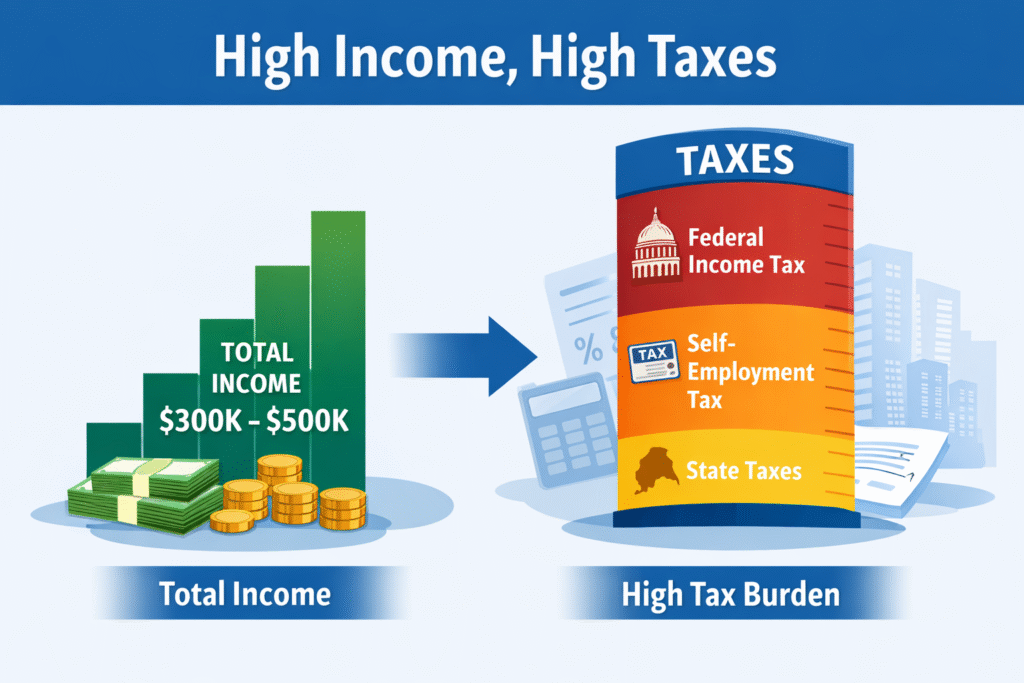
A business owner earns $300,000–$500,000.
They operate as a sole proprietor or basic LLC.
Everything flows through as ordinary income.
That means a large portion of their income is exposed to the highest federal tax brackets.
No restructuring. No forward planning. No timing strategy.
Just filing.
By the time the return is done, the money is already gone.
And this is where most business owners lose control — not because they’re careless, but because no one showed them a better way.
So the real question becomes: what does “a better way” actually look like in practice?
What the Right CPA Actually Changes
Most accountants focus on reporting what already happened.
A strategist changes what happens next.
Here’s a real example of what that looks like:
A business owner comes in earning $400,000 as a sole proprietor.
On paper, everything looks fine.
But when John reviews it, he immediately sees that nearly all of that income is being taxed at ordinary rates — the highest possible exposure.
The first move isn’t filing.
It’s restructuring.
He evaluates whether an S-Corp election makes sense, splits income between salary and distributions, and reduces the portion exposed to self-employment tax.
Then he looks at timing — can income be shifted? Can expenses be accelerated? Can retirement contributions reduce current exposure?
Within the same income level, the tax outcome changes — not slightly, but materially.
This is where strategy begins to show up in dollars, not theory.
And once you understand that, the next question becomes unavoidable:
Why isn’t this happening for most business owners?
Why This Gap Exists in Juneau
It’s not because business owners don’t care.
It’s because the system they rely on isn’t built for strategy.
In a market like Juneau, you’ll often see:
- Seasonal income swings (tourism, fishing, services)
- Multi-state income complications
- Remote operations with unclear tax positioning
But most accountants still operate on a year-end cycle.
They receive numbers after the year is closed.
They prepare the return.
They move on.
There’s no time to influence decisions that already happened.
That’s why two businesses with the same income can end up with completely different tax outcomes.
One is managed.
The other is reported.
Which leads to the deeper shift most owners haven’t been shown yet.
The Financial Fortress Most Business Owners Never Build
Tax strategy is not about paying less this year.
It’s about building something that compounds over time.
Think of it as a financial fortress.
Not a metaphor — a structure.
The foundation is how your income is taxed.
The walls are assets you acquire with tax savings — real estate, investments, retirement accounts.
The protection comes from how those assets are structured and preserved.
Most people never build this.
They earn, they pay, they repeat.
But the tax code is designed differently.
It rewards business ownership, investing, and asset-building — not just income generation.
Which means every dollar you unnecessarily send to taxes is a dollar that never becomes part of that structure.
And this is where the difference compounds over years, not months.
So the question becomes practical again:
What should you actually look for in a CPA if this is the goal?
What to Look for in the Best CPA in Juneau
You’re not looking for someone who can file correctly.
That’s assumed.
You’re looking for someone who changes outcomes.
Here’s how to evaluate that:
- Do they meet with you before year-end, or only after?
- Do they model different tax scenarios, or just record one?
- Do they challenge your current structure, or accept it?
- Do they connect your taxes to long-term wealth, or keep them separate?
For example, if you’re earning $350,000 and no one has ever walked you through how that income could be taxed differently — that’s not a complexity issue.
That’s a strategy gap.
And once you see that gap clearly, the next step is understanding how someone like John actually operates inside it.
How John Geantasio Works With Business Owners
The difference is not a claim — it’s a process.
When a client comes in, John doesn’t start with forms.
He starts with questions most accountants never ask:
- Where is your income coming from — and how is each piece taxed?
- What decisions will you make in the next 6–12 months that affect taxes?
- What part of your income is unnecessarily exposed?
From there, the work becomes specific.
If a client is overpaying due to entity structure, that gets addressed first.
If income timing can be optimized, that gets planned before year-end.
If retirement or investment strategies can reduce tax burden, those are built into the plan.
This is not theoretical.
It’s decision-by-decision adjustments that change the final number.
And over time, those changes don’t just reduce taxes — they build retained wealth.
Which is exactly where most business owners start paying attention.
FAQ: What Business Owners in Juneau Actually Ask
Do I really need tax planning if my accountant already files my taxes?
Yes — because filing and planning happen at completely different times. Filing reports what already happened, while planning changes what happens before the year closes. For example, if you decide on your business structure in December instead of March, you may already have lost the opportunity to reduce that year’s tax burden. Planning ensures decisions are made when they still matter. Without it, even a perfectly filed return can still reflect an avoidable tax bill.
How much difference can tax strategy actually make?
It depends on your income and structure, but the difference is often significant. For instance, a business owner earning $400,000 may reduce exposure by restructuring income between salary and distributions or using retirement strategies. That doesn’t eliminate taxes — it optimizes how they apply. Over several years, that difference compounds into retained capital that can be reinvested. The real impact is not one year — it’s the accumulation over time.
Is this only relevant for high-income business owners?
No, but the impact becomes more visible as income increases. At lower income levels, the tax difference may be smaller in absolute dollars, but the principles still apply. For example, even a $150,000 business can benefit from entity decisions and timing strategies. As income grows, the cost of not planning grows with it. So starting earlier simply means more control over future outcomes.
What makes a CPA “strategic” instead of just “good”?
A strategic CPA influences decisions before they happen. A good compliance CPA ensures accuracy after the fact. For example, a strategic CPA might advise you to shift income, change structure, or invest in a tax-advantaged way months before filing. That advice changes the numbers themselves, not just how they are reported. The difference shows up not in the return — but in what the return reflects.
What Changes From Here
If you’ve read this far, you already know something isn’t working the way it should.
You’re earning — but not keeping enough of it.
Working with John changes how your income is structured, how decisions are timed, and how much of what you earn actually stays with you.
If that’s something you want to fix, the next step is simple:
Book a tax strategy session with John Geantasio CPA LLC and see what your current setup is actually costing you.