The tax problem most Sacramento business owners spot too late
If you run a business in Sacramento, you may already feel the pattern even if you have not named it yet. Revenue grows, the business gets more demanding, and yet the amount you keep never feels proportional to the effort it took to earn it. By the time tax season arrives, the numbers explain what happened, but they do not undo it.
That is the real reason choosing the best CPA in Sacramento matters. In California, the cost of getting the financial side wrong is heavier than in many other states because a business owner is not only dealing with federal taxes, but also California’s high-tax environment, entity decisions, and timing decisions that become expensive once the year is closed. The issue is rarely that a return was filed incorrectly. The issue is that the business was allowed to run for twelve months without anyone redesigning how the income would be taxed.
That is where most owners start losing money, and once you see that, the next question is not who can file a return. It is who can stop that loss before it becomes permanent.
Why Sacramento business owners overpay
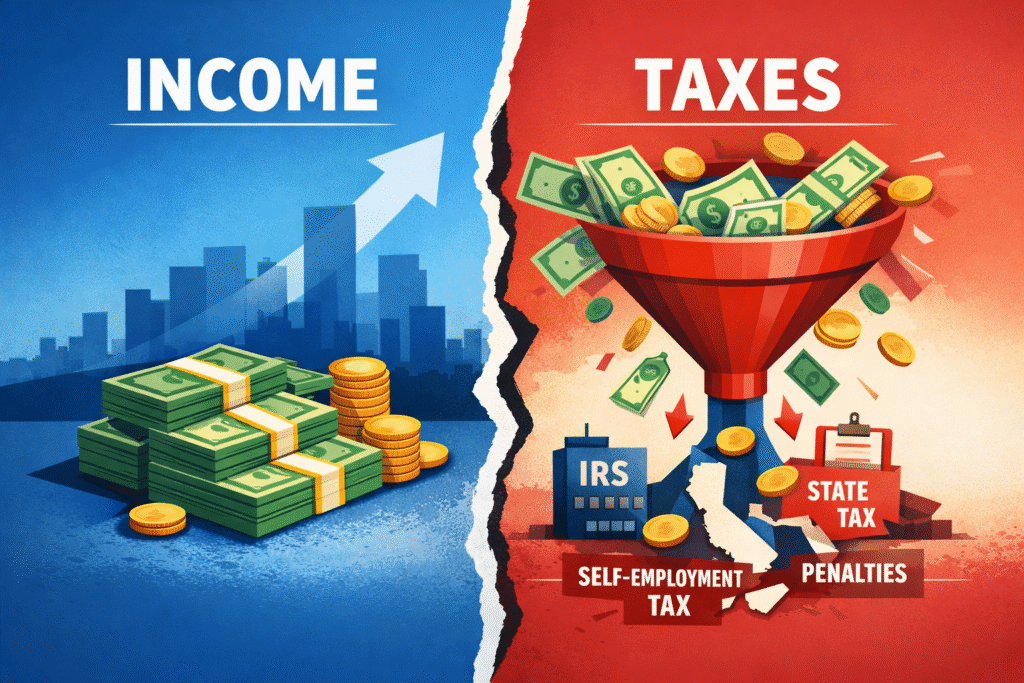
Many business owners in Sacramento start in a perfectly normal way. They form an LLC, keep basic books, hire an accountant, and focus on sales, operations, payroll, and growth. That setup may be fine when profit is still modest. It becomes much more expensive when the same structure is left untouched as the business scales.
Take a simple example. A Sacramento consultant or agency owner earns $400,000 through a single-member LLC. If nobody revisits entity choice, compensation strategy, and where profits should go, a large portion of that income may remain exposed to the highest ordinary income treatment and self-employment taxes. The return can still be prepared accurately, but accuracy at that point does not create savings. It only confirms the cost.
This is why business owners often feel confused after a “clean” filing season. Nothing appears broken, yet too much cash leaves the business. To understand why that keeps happening, it helps to look at what the right CPA actually changes.
What the best CPA in Sacramento actually does
The best CPA in Sacramento is not simply someone who understands tax law. Many professionals understand the rules. The difference is what they do with that understanding while there is still time to influence the result.
A strong CPA starts with decisions, not forms. They look at how income is earned, how it is categorized, how money moves out of the business, and whether the current entity still makes sense for the owner’s level of profit. Instead of asking only what can be deducted, they ask what should change before year-end so the business owner keeps more of what they earn.
That distinction becomes easier to trust when you can see it in a real scenario rather than in a general claim.
How John works with a business owner in practice
When a business owner comes to John earning $400,000 a year as a sole proprietor, he does not begin by scanning for a few overlooked deductions. He begins by measuring how much of that income is being taxed unnecessarily because the structure was never updated as the business grew.
In many cases, the first issue is entity choice. John looks at whether an S corporation election would reduce the amount of income exposed to self-employment tax. He then reviews how much should reasonably be paid as salary and how much can flow as distributions. That is not a cosmetic adjustment. Depending on the facts, it can change the owner’s annual tax burden by tens of thousands of dollars.
From there, the conversation gets more practical. If the owner expects a strong fourth quarter, John looks at whether retirement contributions, equipment purchases, or other timing decisions should happen before year-end. If all profits are being pulled out as personal income, he looks at whether some of that capital should remain positioned for longer-term use instead. The point is not to make the return look better. The point is to make the year look different before the return is ever filed.
That is the type of work that makes a business owner realize the bigger issue was never paperwork. It was what the paperwork reflected.
The financial fortress most owners never build
Once a business owner starts keeping more of what they earn, the next question is what to do with the savings. This is where many people miss the larger opportunity. They treat tax savings as a short-term win rather than as the first layer of a long-term wealth plan.
A better way to think about it is as a financial fortress. The foundation is lower tax drag. The walls are the assets built with the money that no longer leaks out unnecessarily. The protection comes from the fact that those assets can produce value beyond the owner’s day-to-day labor.
In real life, that can mean a Sacramento business owner uses better tax planning to retain more cash, then redirects part of it into retirement accounts, real estate, or other assets that appreciate or generate income. The book you provided makes this principle explicit: the tax code was written to encourage retirement saving, business building, and real estate development, and tax planning works best when tax liabilities are moved into assets that compound over time.
That is why tax planning is not just about lowering a number once. It is about changing what that money becomes over five, ten, or twenty years. And that leads directly to the question many owners ask next: how do you know whether a CPA is actually capable of helping at that level?
How to evaluate a CPA before you hire them
A strategic CPA is not hard to identify once you know what to listen for. They will talk about your income, your entity, your timing decisions, and the financial moves coming up in the next twelve months. They will ask about expansion, major purchases, changes in profitability, and how you are currently taking money out of the business. Their questions reveal whether they are preparing a return or shaping an outcome.
A compliance-focused accountant may still be competent and helpful. But if every conversation happens after the year closes, the value is naturally limited. The tax planning source material you shared makes this distinction clearly: tax planning is a higher level of service than tax preparation because different strategies can work against each other, and choosing the right combination requires interpretation, sequencing, and advance implementation.
That means the best CPA is not simply the person who knows the most rules. It is the person who knows which moves matter for your specific business before the deadline removes your options.
Frequently asked questions
What makes a CPA the best in Sacramento?
The best CPA in Sacramento is the one who changes financial outcomes before they become fixed. Credentials and filing accuracy matter, but those are baseline expectations. What separates a top advisor is the ability to identify where income is being taxed inefficiently and then recommend changes while those changes can still affect the year. For example, if a business owner is still operating under a default structure that no longer fits their profit level, a strategic CPA will flag that early and explain what should change. The practical difference is that the owner does not just get a finished return; they get a better result.
Do I need tax planning if my accountant already files my taxes?
Yes, because filing and planning happen at different points in the process and do different jobs. Filing reports what already happened. Planning changes what happens while you still have choices. If an owner waits until tax season to discuss entity structure, retirement contributions, or income timing, many of the best moves are already unavailable. A well-filed return is still important, but it cannot recover opportunities that were never acted on in time. That is why many owners have accurate returns and still overpay.
Can tax strategy really make a meaningful difference in California?
Yes, and in California the impact can be especially noticeable because the tax burden is already high. A Sacramento owner who improves entity design, reduces unnecessary self-employment exposure, and aligns cash flow with longer-term tax-favored uses may keep materially more money than an owner who simply stays on autopilot. For someone earning a few hundred thousand dollars a year, this can mean tens of thousands of dollars in difference, not just minor savings around the edges. Over several years, those retained dollars can become investment capital rather than recurring leakage. That is where the true value shows up.
Is this only relevant for very high-income businesses?
No, but the impact becomes more visible as income grows. A business earning $100,000 may have fewer levers than one earning $400,000, but both can still benefit from getting entity choice, timing, and capital decisions right. The mistake many owners make is assuming strategy is something to add later, after the business becomes “big enough.” In practice, waiting usually means paying avoidable tax for years first. Starting earlier does not just save money now; it builds better habits for the stage where the dollars become even larger.
What changes from here
If you are a Sacramento business owner and you suspect too much of your income is disappearing into taxes, that instinct is probably pointing at a real problem. Working with John means those decisions are reviewed before the year closes, when changes can still improve the outcome.
You do not need another return explained to you after the fact. You need to know what your current setup is costing you now.
Book a tax strategy session with John and find out what should change before this year decides it for you.