
When people hear “capital gains tax,” they usually think of stocks or real estate. But capital gains tax applies to any asset you sell for more than you paid for it — and how that gain is taxed depends entirely on timing, asset type, and intent.
Handled correctly, capital gains tax can be one of the lowest tax rates in the tax code. Handled poorly, it can quietly erase years of growth.
This guide explains capital gains tax clearly, based on IRS rules, so you understand both the benefits and the risks before you sell
What Is Capital Gains Tax?
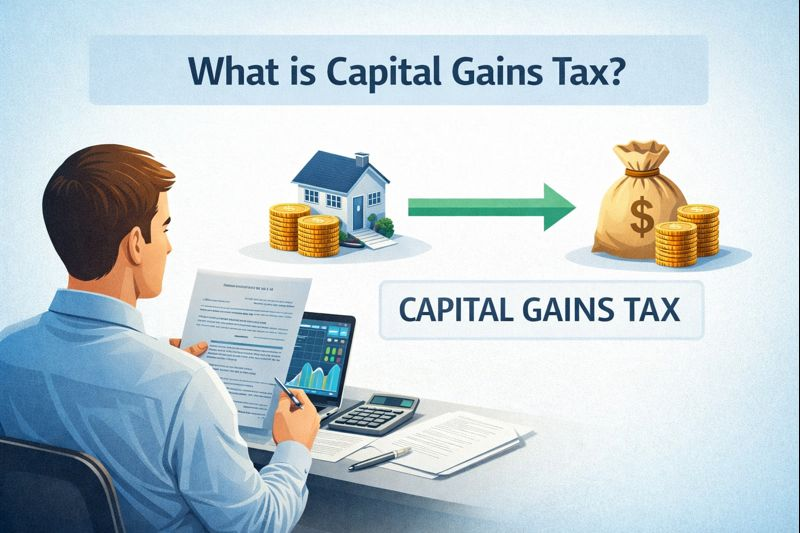
Capital gains tax is the tax you pay when you sell a capital asset for more than its cost basis (generally what you paid, plus certain improvements or acquisition costs).
Common capital assets include:
- Stocks and ETFs
- Real estate
- Business interests
- Investment property
If you sell an asset for less than its cost basis, the result is a capital loss, which may offset other gains.
Capital Gains Tax: Long-Term
What Counts as Long-Term Capital Gains?
A gain is considered long-term if you hold the asset for more than one year before selling it.
How the IRS Taxes Long-Term Capital Gains
Long-term capital gains are taxed at preferential federal rates of 0%, 15%, or 20%, depending on your total taxable income.
Benefits of Long-Term Capital Gains
- Lower tax rates than ordinary income
- Encourages long-term investing
- Can be partially or fully tax-free at lower income levels
Downsides of Long-Term Capital Gains
- Requires longer holding periods
- Large gains can still push income into higher brackets
- State taxes and surtaxes may still apply
Capital Gains Tax: Short-Term

What Counts as Short-Term Capital Gains?
If you sell an asset one year or less after purchasing it, the gain is treated as short-term.
How Short-Term Gains Are Taxed
Short-term capital gains are taxed as ordinary income, subject to your marginal tax rate and applicable state taxes.
Benefits of Short-Term Capital Gains
- Faster access to cash
- Useful for liquidity or short-term strategies
Downsides of Short-Term Capital Gains
- Highest tax rates apply
- Can create unexpected tax bills
- Often overlooked until filing season
Capital Gains Tax on a Home Sale

IRS Home Sale Exclusion Rules
The IRS allows qualifying homeowners to exclude:
- Up to $250,000 of gain (single filers)
- Up to $500,000 of gain (married filing jointly)
To qualify, you must own and live in the home as your primary residence for at least two years during the five-year period before sale.
Benefits of the Home Sale Exclusion
- Large portion of gain may be tax-free
- One of the most valuable tax benefits available
Limitations to Watch
- Rental or business use can reduce the exclusion
- Depreciation recapture may still apply
- Frequent moves can limit eligibility
Capital Gains Tax Rates (At a Glance)
Capital gains tax rates depend on how long you held the asset and your total taxable income.
- Short-term gains → ordinary income tax rates
- Long-term gains → reduced capital gains rates
High-income taxpayers may also be subject to the Net Investment Income Tax (NIIT).
How to Save Capital Gains Tax (Legally)
Capital gains tax can often be reduced or deferred with IRS‑approved planning strategies. Below are the most common legal approaches, along with where they help and where they fall short.
Long‑term holding: Assets held over one year qualify for lower capital gains rates instead of ordinary income rates.
Benefit: Lower federal tax rates.
Limitation: Requires timing and patience.
Tax‑loss harvesting: Capital losses can offset gains dollar‑for‑dollar, with excess losses carried forward.
Benefit: Directly reduces taxable gains.
Limitation: Subject to wash‑sale rules.
Primary residence exclusion: Up to $250,000 (single) or $500,000 (married filing jointly) of gain may be excluded if ownership and use tests are met.
Benefit: Large tax‑free exclusion.
Limitation: Applies only to qualifying home sales.
Deferral strategies: Installment sales, 1031 exchanges (real estate only), and Qualified Opportunity Zone investments can defer or reduce capital gains.
Benefit: Preserves cash flow.
Limitation: Strict IRS compliance required.
Charitable planning and estate strategies: Donating appreciated assets or relying on a step‑up in basis at death can eliminate capital gains entirely.
Benefit: Maximum tax efficiency.
Limitation: Requires long‑term planning.
Capital gains tax can often be reduced by holding assets longer than one year, timing sales in lower-income years, using capital losses to offset gains, qualifying for the primary residence exclusion, or deferring gains through strategies like 1031 exchanges. Planning before selling matters more than deductions after.
Capital Gains Tax for Stocks

How Stock Gains Are Taxed
Stock sales follow the same holding-period rules. Brokerage firms report transactions directly to the IRS, making accurate reporting essential.
Benefits of Stock Capital Gains
- Favorable long-term rates
- Easy documentation through brokerage statements
- Losses can offset gains
Downsides of Stock Capital Gains
- Frequent trading increases tax exposure
- Market timing mistakes can increase taxes
- Wash-sale rules limit loss deductions
Capital Gains Comparison Table
| Type of Gain | Holding Period | How It’s Taxed | Key Benefit | Main Risk |
| Short-Term Gain | 1 year or less | Ordinary income | Quick liquidity | Highest tax cost |
| Long-Term Gain | Over 1 year | 0%, 15%, or 20% | Lower tax rates | Requires patience |
| Primary Home Sale | 2 of last 5 years | Up to $250k/$500k excluded | Tax-free gain | Qualification limits |
| Stock Gains | Varies | Short or long-term | Flexible timing | Trading mistakes |
| Investment Property | Usually long-term | Capital gains + recapture | Wealth building | Complexity |
Next Steps

Capital gains tax rewards patience and planning — and penalizes rushed decisions. Two people can sell the same asset for the same price and pay very different taxes based solely on timing and structure.
If you’re planning to sell stocks, real estate, or a business interest, the most important tax decisions happen before the sale, not after.
Schedule a consultation with John E. Geantasio CPA to review your capital gains exposure and plan the sale the right way.