A Complete Guide to Refund Timing, Processing Delays, and What Taxpayers Should Expect
Understanding when your federal income tax refund will arrive is one of the most common concerns during tax season. For the 2026 filing season, the Internal Revenue Service (IRS) has provided guidance on processing timelines, refund tracking tools, and situations that may delay payment.
This advisory article explains the IRS Income Tax Refund Schedule for 2026 using official IRS guidance and professional tax analysis so taxpayers can plan appropriately.
Overview of the 2026 Filing Season

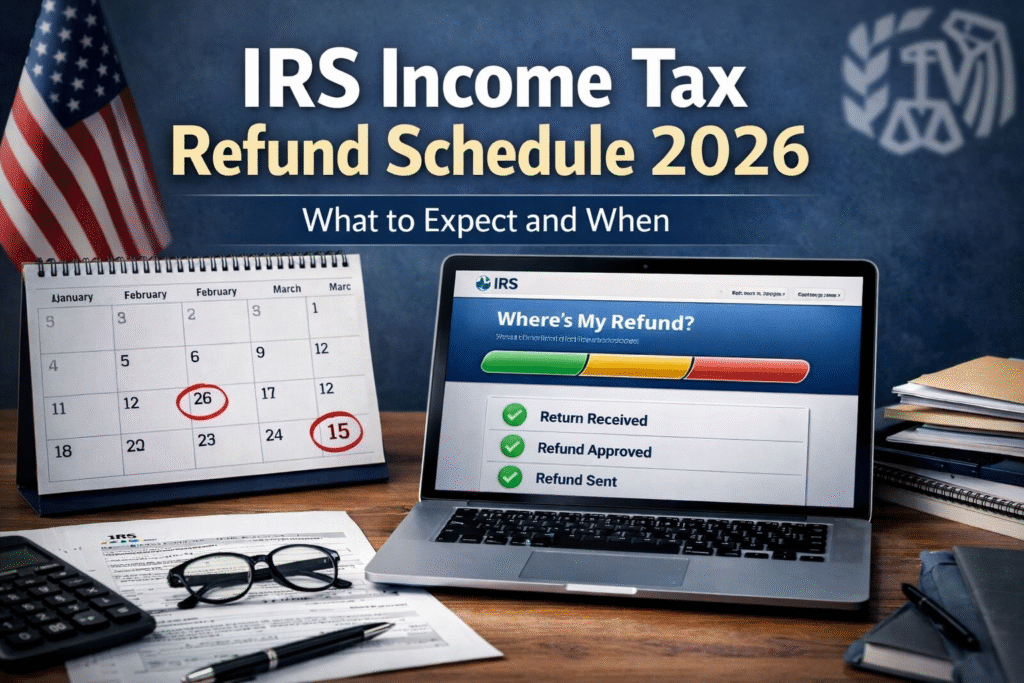
The IRS officially opened the 2026 tax filing season on January 26, 2026, and began accepting federal income tax returns for the 2025 tax year.
The standard federal income tax filing deadline is April 15, 2026, unless adjusted due to a federal holiday or weekend.
Taxpayers should always confirm official announcements directly at:
What Is a Tax Refund?
A tax refund occurs when a taxpayer has paid more federal income tax during the year than they legally owed. This typically happens because:
- Employers withhold federal taxes from wages.
- Taxpayers make estimated quarterly payments.
- Taxpayers qualify for refundable credits.
After filing your return, the IRS calculates your final tax liability. If total payments exceed your liability, the IRS issues a refund for the difference.
More information about refunds can be found at:
How Long Does It Take to Receive a Refund in 2026?
The IRS states that most refunds are issued within approximately 21 days after the agency accepts an electronically filed return when direct deposit is selected.
However, several variables influence timing:
- Filing method
- Payment method
- Accuracy of return
- Identity verification requirements
- Eligibility for certain credits
The IRS does not guarantee exact refund dates.
2026 Estimated IRS Refund Timeline
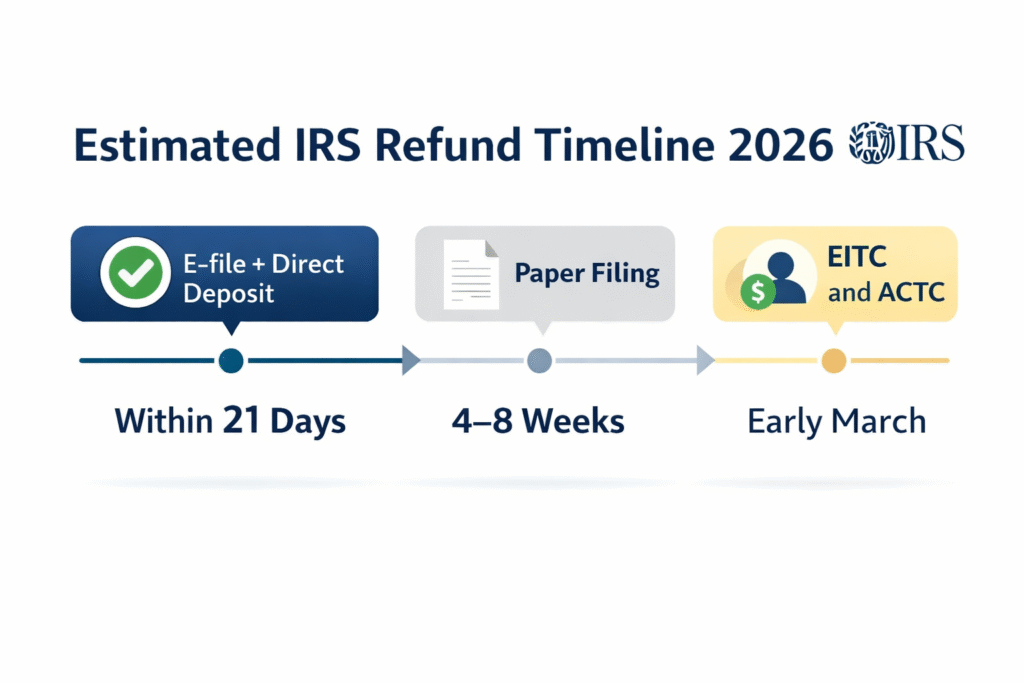
The following table summarizes general processing expectations based on IRS guidance:
| Filing Method | Estimated Refund Timing |
| E-file + Direct Deposit | Most refunds are issued within about 21 days |
| E-file + Paper Check | Typically longer than direct deposit |
| Paper Filing | Often 4–8 weeks or more |
| Amended Returns | Significantly longer processing time |
Electronic filing with direct deposit remains the fastest and most reliable method.
Refund Timing for EITC and ACTC Claims
Federal law requires additional review for tax returns claiming:
- Earned Income Tax Credit (EITC)
- Additional Child Tax Credit (ACTC)
The IRS cannot issue refunds involving these credits before mid-February. For the 2026 filing season, most refunds involving these credits are expected to become available by early March for taxpayers who file early and choose direct deposit.
This review requirement helps prevent fraud and improper payments.
Official IRS filing season announcement:
Why Refunds May Be Delayed in 2026
While many refunds are processed quickly, delays can occur for legitimate reasons.
1. Errors on the Tax Return
Common errors that slow processing include:
- Incorrect Social Security numbers
- Mismatched names
- Incorrect bank routing or account numbers
- Math errors
- Missing forms
Even minor mistakes can cause automated systems to flag the return for review.
2. Identity Verification
If the IRS suspects identity theft or fraudulent filing activity, the return may require identity verification. In these cases, the IRS will contact the taxpayer directly by mail with instructions.
3. Paper Filing
Paper returns require manual processing. During peak filing periods, paper returns can take significantly longer to process compared to electronic filings.
4. Amended Returns
If you file an amended return using Form 1040-X, processing time is substantially longer. Amended return processing can take several months.
5. Refund Offsets
Your refund may be reduced or eliminated if you owe certain government debts. This process is called a refund offset.
Refunds may be offset for:
- Past-due child support
- Federal student loans in default
- State income tax liabilities
- Certain federal agency debts
If an offset occurs, the IRS sends a notice explaining:
- The original refund amount
- The amount applied toward debt
- The agency receiving payment
- The remaining refund balance, if any
More information about offsets is available through the Bureau of the Fiscal Service:
How to Track Your Refund in 2026
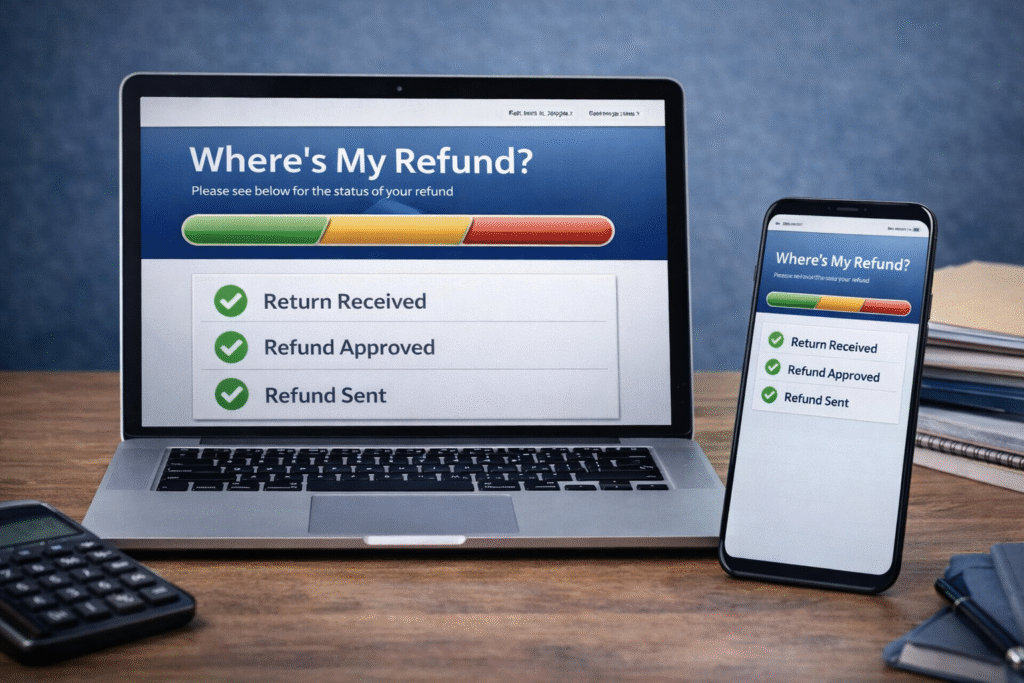
The IRS provides an official refund tracking tool called “Where’s My Refund?”
To use the tool, you will need:
- Social Security number or ITIN
- Filing status
- Exact refund amount
The system updates once daily and provides three stages:
- Return Received
- Refund Approved
- Refund Sent
The IRS2Go mobile app provides the same functionality.
Taxpayers should rely only on official IRS tools for refund tracking.
Factors That Can Impact Refund Amount
Refund amounts vary significantly based on:
- Total income
- Filing status
- Withholding levels
- Credits claimed
- Deductions claimed
- Estimated payments made
It is important to remember that a large refund does not necessarily mean lower taxes. In many cases, a large refund indicates over-withholding throughout the year.
Tax planning can help taxpayers optimize withholding to avoid excessive overpayment.
Best Practices to Avoid Refund Delays
To improve the likelihood of smooth and timely processing:
- File electronically using IRS-approved software.
- Choose direct deposit for refund delivery.
- Verify all identifying information before submission.
- Ensure all W-2 and 1099 forms are included.
- Avoid estimating income; use official documents.
- File early to avoid peak-season delays.
Electronic filing combined with direct deposit consistently results in the fastest refunds.
Common Refund Questions for 2026
When will the IRS start issuing refunds in 2026?
Refund processing begins after the IRS starts accepting returns, which occurred on January 26, 2026.
Can I receive my refund in less than 21 days?
While some refunds are issued faster, the IRS states most refunds are issued within about 21 days after acceptance for electronically filed returns with direct deposit.
Why is my refund taking longer than 21 days?
Possible reasons include:
- EITC or ACTC claims
- Identity verification
- Errors on the return
- Paper filing
- Refund offset
- Additional IRS review
Does calling the IRS speed up the process?
No. The IRS recommends checking “Where’s My Refund?” before contacting the agency. Phone representatives typically have access to the same information as the online tool.
What happens if my direct deposit information is wrong?
If banking information is incorrect, the refund may be rejected by the bank and returned to the IRS. This will significantly delay issuance.
Professional Advisory Perspective
From a CPA standpoint, taxpayers should focus not only on refund timing but also on refund accuracy and compliance.
Key recommendations:
- Review your withholding annually.
- Avoid relying on refund anticipation loans.
- Maintain documentation for all credits claimed.
- Monitor IRS correspondence carefully.
Tax refunds should be viewed as part of broader financial planning, not simply as a seasonal event.
Official IRS Resources
Refund Status Tool:
https://www.irs.gov/refunds
IRS Filing Season Newsroom:
https://www.irs.gov/newsroom
Refund Offset Information:
https://www.fiscal.treasury.gov/top
Taxpayers are encouraged to verify updates directly through IRS.gov, as processing guidance can change.
Important Professional Disclaimer
This article provides general informational guidance regarding the 2026 IRS income tax refund schedule. It does not constitute legal, tax, or financial advice. Individual tax situations vary significantly. Taxpayers should consult a licensed CPA or qualified tax professional for advice specific to their circumstances. Always verify filing dates and refund processing information directly through IRS.gov.
Final Summary
For the 2026 tax season:
- Filing season opened January 26, 2026.
- Most electronically filed refunds with direct deposit are issued within approximately 21 days.
- Refunds involving EITC or ACTC may not be available until early March.
- Refunds may be reduced due to government debt offsets.
- The “Where’s My Refund?” tool is the most reliable source for tracking.
By filing accurately, choosing electronic submission, and selecting direct deposit, taxpayers can generally expect the most efficient refund processing under current IRS procedures.
If you have questions about your 2026 tax refund, withholding strategy, or whether you are overpaying throughout the year, John Geantasio CPA can help.
Tax refunds are only one piece of the bigger picture. Proper tax planning can help you improve cash flow, reduce surprises, and stay compliant with IRS rules.
To schedule a consultation, contact John Geantasio CPA today and get clear guidance tailored to your situation.