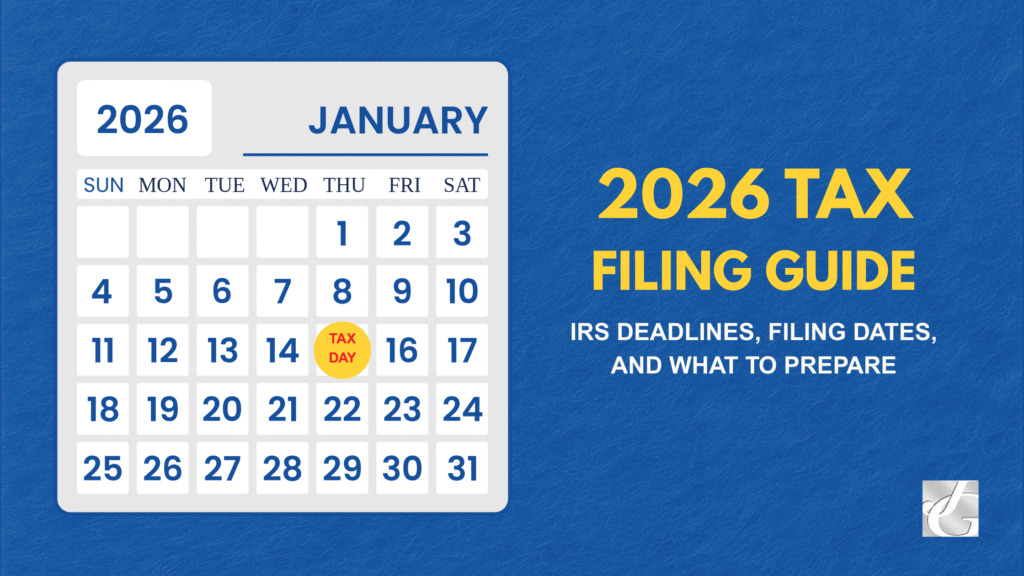
IRS Filing Start Date for 2025 Taxes: Late January 2026
The exact date will be announced by the IRS in early January 2026.
Every year, millions of taxpayers ask the same question as tax season approaches:
When can I file my taxes?
If you’re planning for the 2026 tax season, this guide explains exactly when you can file your 2025 taxes, which documents you’ll need, the key IRS deadlines, what happens if you file early, and how extensions actually work
Whether you’re a business owner, self-employed professional, real estate investor, or a regular W-2 earner, this guide will help you prepare confidently and avoid delays.
When Does the IRS Allow You to File 2025 Taxes?
The IRS never accepts returns on January 1.
Before opening filing season, the IRS must:
- Update its systems
- Program current-year tax law changes
- Finalize electronic filing security checks
- Prepare refund processing systems
That’s why filing season typically opens in the last 7–10 days of January.
Historical IRS Opening Dates:
- 2024 season: January 29
- 2023 season: January 23
- 2022 season: January 24
2026 IRS Filing Calendar for 2025 Taxes
Below is the complete tax filing timeline for your 2025 return:
| Filing Event | IRS Date (Expected/Standard Rule) | Notes |
| IRS Opens Filing | Late January 2026 | E-file + paper accepted |
| Employers Send W-2/1099 | January 31, 2026 | Required before filing |
| Standard Filing Deadline | April 15, 2026 | File & pay taxes |
| Extension Deadline | October 15, 2026 | Only extends filing |
| IRA/HSA Contribution Deadline | April 15, 2026 | Helps reduce taxes |
| Refund Processing Begins | Late Jan – Early Feb 2026 | First refunds issued |
| Typical Refund Window | 7–21 days (e-file) | Much slower for paper returns |
What Forms Do You Need Before Filing?
Before you file your tax return, the IRS requires all income-related and deduction-related documents to be complete. Filing early without proper forms can cause delays or require amendments.
Income Forms
- W-2 (employee wages)
- 1099-NEC (self-employment)
- 1099-K (Payment apps: PayPal, Venmo, Stripe, Etsy, Uber, DoorDash, Airbnb)
- 1099-INT (bank interest)
- 1099-DIV (dividends)
- 1099-B (brokerage transactions, crypto sales)
- 1099-MISC (miscellaneous income)
Deduction/Credit Forms
- 1098 (mortgage interest)
- 1095-A (Marketplace health insurance form — missing this stops refunds)
- Property tax payment statements
- HSA contribution statements
Employers and institutions must send these forms by January 31, 2026.
Do not file early without them.
Can You File Early? Yes — But With Limits
You can prepare your tax return early using a tax professional, but the IRS will only accept the return once the filing season officially opens in late January.
Filing early is smart because:
- You get your refund faster
- You avoid identity theft
- You can correct errors before the deadline
- You gain more time to contribute to an IRA or HSA
- Tax professionals have more availability in January–February
Thousands of taxpayers discover missed deductions or errors in March—when it’s already too late to fix their tax bill for the year. Preparing early eliminates that risk.
Why Filing Early Helps You Avoid Refund Delays
Every year, millions of refunds are delayed due to preventable mistakes. Filing early helps avoid:
- Missing 1099 or 1095-A forms
- Incorrect Social Security numbers
- Income mismatches between your return and IRS systems
- Duplicate dependent claims
- Direct deposit errors
- Filing during peak IRS backlog season
The earlier you file, the faster the IRS processes your return—especially if you use e-file + direct deposit.
Common Questions About Filing 2025 Taxes in 2026
1. Can we file an income tax return for assessment year 2025–2026?
Yes.
You can file your 2025 U.S. tax return (Assessment Year 2025–2026) once the IRS opens filing season in late January 2026.
2. What is the new tax regime in 2025–2026?
The U.S. tax system updates annually for inflation.
The IRS adjusts:
- Tax brackets
- Standard deduction
- Retirement contribution limits
- HSA contribution limits
Official 2025 numbers are released by the IRS every November.
3. What is the financial year 2025 to 2026?
In the United States:
- Financial Year (Tax Year) 2025 = January 1 to December 31, 2025
- You file this tax year in 2026
4. What is the tax plan for 2026?
Your 2026 tax planning includes:
- Filing your 2025 tax return between January and April
- Maximizing IRA/HSA contributions before April 15
- Reviewing entity structure (LLC/S-Corp)
- Preparing estimated tax payments for 2026
- Identifying new deductions, credits, or depreciation options
A tax professional can help tailor a strategy based on your income and goals.
5. Is ITR filing deadline extended for 2025?
The standard U.S. deadline remains April 15, 2026.
However, you can request an extension using Form 4868.
- Extended filing deadline: October 15, 2026
- Tax payment still due: April 15, 2026
6. How is $12 lakh tax-free?
For U.S. taxpayers, income is measured in dollars, not lakhs.
But if someone is asking whether $120,000 (approx. ₹12 lakh) can be completely tax-free:
No — $120,000 is taxable under U.S. law.
However, the taxable amount can be reduced through:
- Standard deduction
- Business deductions
- Retirement contributions
- HSA contributions
- Credits (child tax credit, education credits)
- Depreciation (for business owners + investors)
But it cannot be 100% tax-free automatically.
Google often mixes Indian tax queries with U.S. tax queries, so clarifying this avoids confusion for American readers.
Understanding Tax Extensions (Most People Get This Wrong)
Many taxpayers believe an extension gives them more time to pay, but the IRS is very clear:
An extension does NOT extend your time to pay.
It only extends your time to file.
Deadline to File with Extension:
October 15, 2026
Deadline to Pay Taxes (even if extended):
April 15, 2026
If you owe taxes and miss the April deadline, the IRS will add:
- Late payment penalties
- Monthly interest charges
- Potential IRS notices
If you need an extension, always estimate your tax bill and make a payment by April 15 to avoid penalties.
If you miss the April 15 tax payment deadline, the IRS doesn’t wait — penalties start immediately, and interest compounds every single month.
One missed deadline can turn a small tax bill into a large IRS problem, so act early before the fees snowball.
Final Thoughts — John’s Message to Every Taxpayer
Here’s what I want you to remember about the 2026 filing season:
Tax season is only stressful for people who wait.
When you prepare early, organize your documents, and understand the IRS deadlines, filing becomes simple — and you get to keep more of your money.
Every year, I see two types of taxpayers:
1. Those who plan early and save thousands
They file on time, avoid penalties, reduce their tax bill, and never hear from the IRS.
2. Those who wait until April and hope for the best
They miss deductions, file with mistakes, and end up paying more than they should.
You deserve to be in the first group.
Filing your 2025 taxes in 2026 is more than checking boxes — it’s a chance to strengthen your financial life. The earlier you start, the more control you have.
And remember:
A well-prepared tax return is not an expense. It’s a strategy.
When done right, it protects your income, builds wealth, and reduces your stress.
If you want to make 2026 your smoothest filing season yet, start now.
Get your documents ready, understand the deadlines, and let a tax professional guide you before small issues become big problems.
John Geantasio, Tax Professional