
New York City is often a testing ground for national ideas — and few proposals have drawn as much attention in 2025 as Assemblymember Zohran Mamdani’s tax plan. Framed as a blueprint to make the city more affordable and equitable, it proposes raising taxes on large corporations and the city’s wealthiest residents to fund sweeping social programs.
For supporters, the plan represents fairness — a demand that those who have gained most from New York’s success give more back. For critics, it’s a risky gamble that could push jobs and investment elsewhere.
Below, we break down Mamdani’s tax plan through the six key questions shaping the debate integrating verified data, fiscal estimates, and reality checks from independent analyses.
Zohran Mamdani’s Tax Hike Plan
Mamdani’s “tax hike” proposals have generated headlines — and for good reason. They involve substantial increases to existing rates, along with new enforcement and spending ideas.
1. The Core Proposals
- Corporate Tax Increase
Mamdani proposes raising New York State’s top corporate tax rate from 7.25 percent to 11.5 percent, claiming this would yield roughly $5 billion a year in new revenue.
Reality Check:- The 7.25% rate applies to most large corporations at the state level, not the city. New York City has no independent power to raise that rate — only the state legislature can.
- So, Mamdani’s plan would require state approval, not just a City Council vote.
- The $5 billion revenue figure is unverified. Analyses from the New York Fiscal Policy Institute and Empire Center estimate a more likely range of $2.5 billion to $4 billion, depending on corporate behavior and relocation risk.
- The 7.25% rate applies to most large corporations at the state level, not the city. New York City has no independent power to raise that rate — only the state legislature can.
- “Millionaire Tax” Surcharge
Mamdani advocates a 2% city income-tax surcharge on income above $1 million, affecting about 1 percent of filers and projected to generate $4 billion annually.
Reality Check:- Independent analysts, including the Citizens Budget Commission, estimate a more realistic gain of $2.2 – $2.5 billion, not $4 billion.
- The discrepancy arises because many high-income households reduce exposure by relocating or restructuring income.
- Independent analysts, including the Citizens Budget Commission, estimate a more realistic gain of $2.2 – $2.5 billion, not $4 billion.
- Procurement and Enforcement Reforms
The plan adds another $1 billion through tighter auditing, ending no-bid contracts, and pursuing unpaid fines — particularly from large landlords.
Reasonable Assumption:
Auditing and procurement reforms could indeed recover hundreds of millions, though reaching a full billion yearly would require major administrative overhaul.
2. The Broader Context
Mamdani argues that New York’s fiscal imbalance is moral, not mathematical: working families pay proportionally more while corporations and the ultra-rich benefit most from city infrastructure. His plan, he says, would correct that imbalance and “make affordability a right, not a privilege.”
Critics disagree. The Empire Center calls it “aspirational but economically risky,” warning that high-income taxpayers are highly mobile. Even a small outflow could erase expected gains.
Economists on the left counter that investments in childcare and transit could stimulate long-term growth by freeing household income and raising labor participation. Whether the math works depends on behavioral response — an area Mamdani’s team hasn’t modeled publicly.
Zohran Mamdani’s Tax Plan
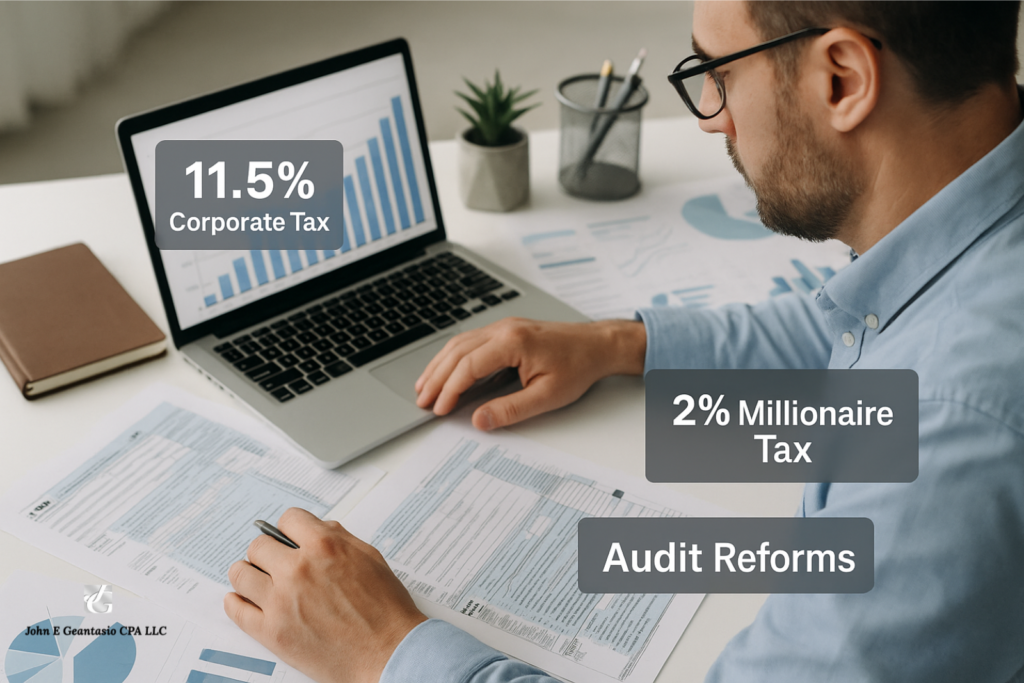
Beyond rate hikes, Mamdani’s plan envisions a restructured tax system paired with new social spending.
1. Structural Elements
a. Corporate Tax Reform
Corporations would face the 11.5 percent top rate — comparable, Mamdani says, to New Jersey.
Reality Check:
That comparison is outdated. New Jersey’s temporary 11.5 percent corporate surtax expired in 2024, returning its effective rate to 9%. So if New York adopted 11.5%, it would be the highest in the nation, not equal to New Jersey.
b. Millionaire Surcharge
Applies only to income above $1 million — a structure meant to spare the middle class.
Reality Check:
While limited to the top 1%, such filers contribute over 40% of city income-tax receipts. Even minor relocation could cut deeply into revenue.
c. Property-Tax Reform
Aims to shift burden from outer borough homeowners to expensive Manhattan properties.
Accurate and Necessary:
Studies show outer-borough homeowners often pay higher effective rates despite lower home values. Reform could create fairer alignment, though it would spark political resistance from high-value districts.
d. Procurement and Audit Reform
Ending no-bid contracts and increasing audits could tighten fiscal controls. Analysts agree these are good-governance steps even if revenue impact is smaller than projected.
2. How the Money Would Be Spent
Mamdani links each new dollar to visible benefits:
- Universal Childcare – Free or low-cost childcare citywide.
- Free Bus Service – Zero-fare buses to improve mobility.
- City-Owned Grocery Stores – To address food deserts and rising prices.
- Affordable Housing Expansion – Construction and rehabilitation of units.
- Public Service Upgrades – Sanitation, infrastructure, and neighborhood improvements.
He calls it an “affordability revolution”, designed to relieve household pressure and strengthen economic participation.
Reality Check:
The combined cost of universal childcare, free transit, and public grocery networks could exceed $15 – 18 billion annually, far above the ≈ $10 billion the plan might raise even under ideal conditions.
That means the plan cannot fully fund all promised programs simultaneously without additional borrowing or phased rollout.
3. Political and Legal Feasibility
Perhaps the greatest hurdle isn’t math — it’s authority.
Reality Check:
The city cannot unilaterally raise state corporate or income-tax rates. Those powers lie with the New York State Legislature. Governor Kathy Hochul has already said she opposes new millionaire tax increases, citing fears of taxpayer flight.
So even if the City Council and Mayor backed Mamdani, state approval is mandatory, making passage politically uphill.
4. The Vision Behind the Numbers
At heart, Mamdani’s tax plan isn’t just about revenue — it’s about values. He describes it as a “redistribution of power through the budget”, arguing that public policy should serve working people first.
Supporters say it redefines fairness; critics say it risks turning aspiration into arithmetic errors.
Either way, it’s forced New Yorkers to reconsider who really pays for the city’s prosperity.
What Companies Support Zohran Mamdani’s Tax Plan?
When it comes to business backing, Mamdani’s plan stands largely alone.
1. Corporate Reactions
To date, no major corporation has publicly endorsed his proposals. Financial firms, tech giants, and real-estate developers have instead voiced concern that raising taxes will reduce competitiveness and push investment elsewhere.
At a 2025 economic-policy roundtable, Mamdani invited over 100 business leaders to discuss his ideas. Notably, JPMorgan CEO Jamie Dimon and several top-tier executives declined. Those who attended reportedly viewed the plan as “bold but unrealistic.”
2. Organizational and Grassroots Support
While big business keeps its distance, Mamdani has won endorsements from progressive advocacy groups, labor unions, and tenant organizations. These include New York Communities for Change, various DSA chapters, and public-sector unions that see his plan as a vehicle for equity.
They argue that corporations rely on public goods—roads, subways, police, and schools—and should therefore contribute proportionally.
3. Expert Commentary
A handful of economists sympathetic to redistributive taxation call the plan “theoretical but consistent” with urban-equity goals. Yet, absent corporate support, its success would depend entirely on grassroots political power rather than private-sector cooperation.
Can I Use Online Tax-Preparation Services to Apply Zohran Mamdani’s Tax Plan Benefits?

No — and it’s important to understand why.
1. The Plan Is Still a Proposal
Reality Check:
As of 2025, the plan is not law. Mamdani is a state assemblymember, not a city official with tax-levying authority, and he is not a declared mayoral candidate. Any tax change requires state legislation and the governor’s signature.
2. How Tax Software Works
Programs like TurboTax or H&R Block only include enacted laws. Since Mamdani’s plan hasn’t passed, these systems cannot reflect his rates, surcharges, or deductions.
Moreover, his proposal doesn’t create new credits for individuals — it primarily raises taxes on corporations and top earners. There’s nothing for average filers to “apply.”
3. Future Scenario
If the plan (or a modified version) were adopted, the New York State Department of Taxation and Finance would issue official rate tables and instructions, and software companies would update automatically. Until then, any platform claiming to apply Mamdani’s tax benefits is misleading.
Where Can I Find Detailed Summaries of Zohran Mamdani’s Tax Plan?
Let’s summarize the facts — separating vision from verifiable reality.
1. The Claim vs. The Reality
| Claim | Assessment / Reality Check |
| Raise NY State corporate tax from 7.25% to 11.5% | Misleading – That rate is set by the state, not the city. It would need legislative approval. |
| Expected $5 B in new revenue | Questionable – Independent estimates range from $2.5 – $4 B. |
| 2% Millionaire Surcharge adds $4 B | Likely Overstated – Realistic projection ≈ $2.2 – $2.5 B. |
| Programs fully funded by plan | Incorrect by Implication – Combined cost ≈ $15–18 B, exceeding revenue. |
| Mirrors New Jersey structure | Outdated Comparison – NJ’s 11.5% rate expired 2024. |
| Part of mayoral platform | False – Mamdani is a state assemblymember, not a declared mayoral candidate. |
2. The Big Picture
At its core, the Zohran Mamdani Tax Plan is an attempt to rethink who pays for New York City’s growth. It seeks roughly $10 billion in new annual revenue by raising rates on the wealthiest individuals and large corporations, using that money to fund childcare, housing, and transportation benefits for working families.
But even if every element passed unchanged, the funding would still cover only a portion of his social agenda. The city would need to phase in programs or seek additional sources to avoid budget shortfalls.
3. The Economic Debate
Supporters say it’s time to reverse a decade of trickle-down tax policy and redirect wealth toward the public good. They argue New York can afford this shift because its economic base is deep and diverse.
Critics warn of behavioral effects: wealthy individuals can move residency to low-tax states, corporations can shift profits across jurisdictions, and property values can decline if burdens grow. Those reactions could undermine the very revenue the plan relies on.
Both sides agree on one thing: the status quo is unsustainable. New York’s cost of living is sky-high, and without new solutions, the city risks pricing out the workers who keep it running.
Final Reflection

Zohran Mamdani’s tax plan is among the most ambitious and controversial economic proposals to emerge from New York in years. It promises a more equal city funded by those with the greatest means. But beneath the idealism lies hard math and tough politics: state approval is mandatory, revenue projections are uncertain, and program costs likely exceed income.
Still, the proposal has already accomplished something important — it has forced New Yorkers to reconsider what “fairness” really means. Should the rich pay more to fund childcare and transit? Can a city be competitive and compassionate at the same time?
Whether Mamdani’s plan becomes policy or remains an aspirational blueprint, it marks a turning point in the conversation about tax justice and urban governance. For some, it’s a roadmap to a fairer future; for others, a cautionary tale of good intentions outpacing economic reality.
What no one can deny is this: the debate has begun, and New York — true to form — is once again the place where America tests its boldest ideas.