Reviewed by John Geantasio, CPA — August 2026. All figures reflect 2026 limits published by the IRS.
For a W-2 employee, retirement planning and tax planning are separate conversations. Pick a contribution rate, pick a fund lineup, and the tax return just reflects what happened.
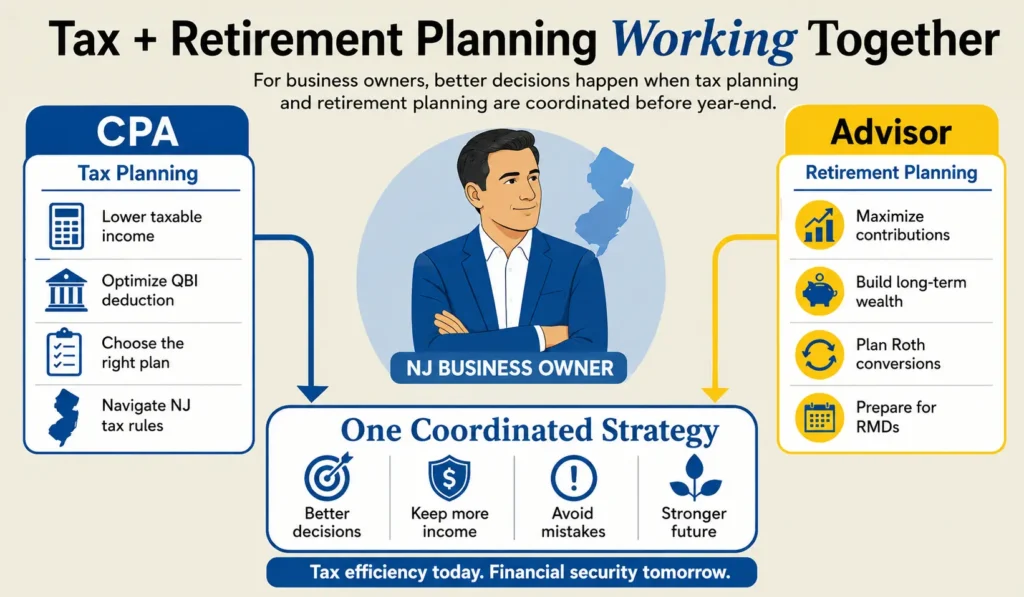
For a business owner, that separation is false. Retirement planning for business owners is a tax decision first — which plan you set up, how much you contribute, whether you take money as salary or distribution, and when you convert to a Roth. The account is only where the decision lands.
The problem is structural. Most owners have a CPA who files the return and a financial advisor who manages the account. The two compare notes after a decision is made instead of before. We coordinate it on purpose, and the difference shows up as real dollars.
Why does retirement planning for business owners need tax coordination?
Because the contribution isn’t a payroll deduction someone else calculates. It’s a number you or your advisor sets, and every input to that number is also a tax input. Three examples make it concrete.
Plan selection changes what you can deduct, and when
A SEP-IRA, a Solo 401(k), and a cash-balance plan each cap contributions differently. The cap is driven by how your business income is structured — net self-employment earnings, W-2 wages from an S-corp, or an actuarial formula tied to age and target benefit.
Pick the wrong plan for your entity structure and you leave real deduction on the table. Or you over-contribute and create a correction problem that costs more to fix than the deduction was worth.
Your S-corp salary and your retirement contribution are one decision
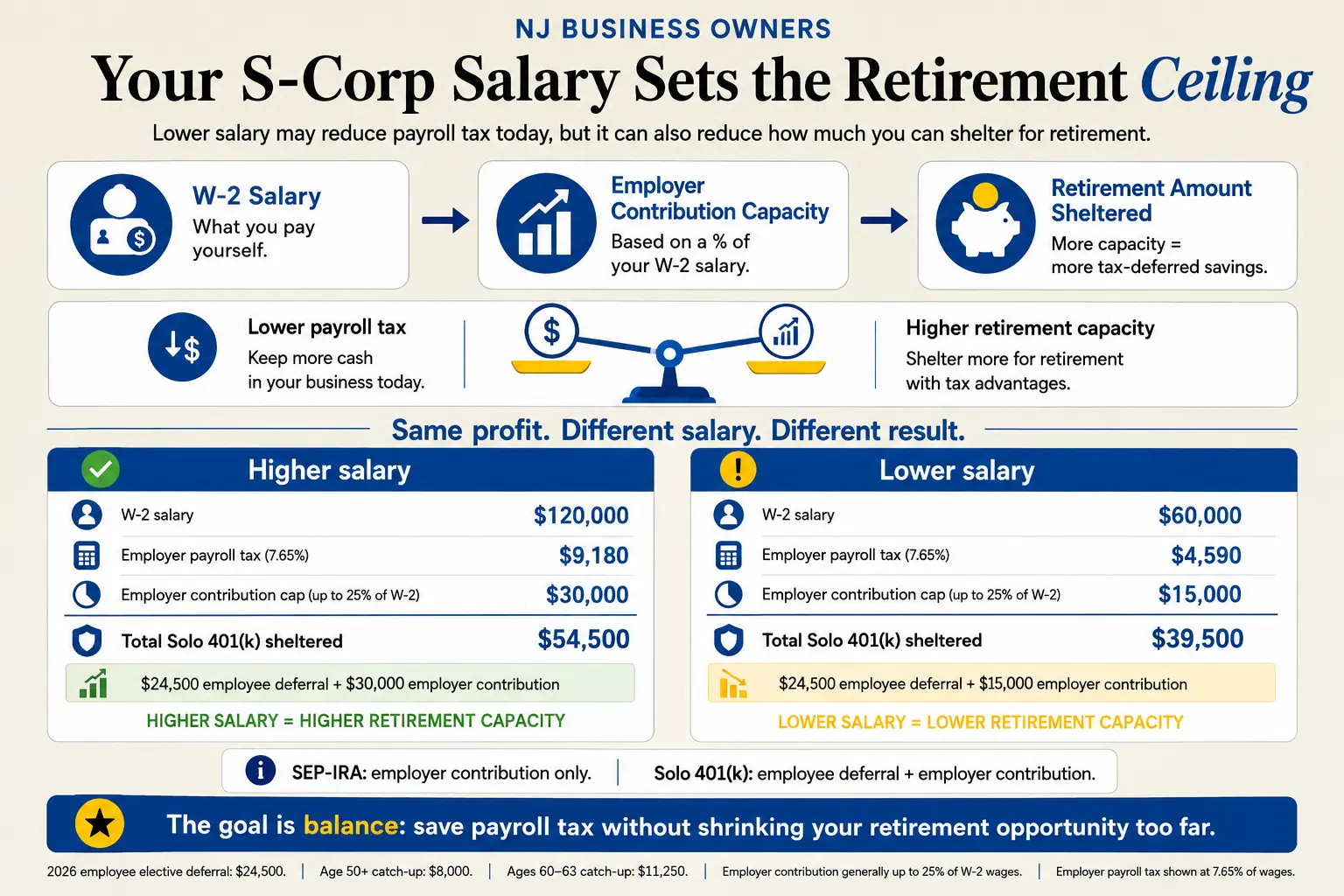
If you run payroll through an S-corp, your Solo 401(k) or SEP employer contribution is capped as a percentage of your W-2 wages — not your business’s total profit.
Set your reasonable salary too low to save on payroll tax and you have also quietly capped how much you can shelter for retirement. We see this constantly. An owner optimizes salary purely for payroll-tax savings without realizing it shrinks the retirement contribution ceiling by the same stroke.
The contribution changes your tax bill in more than one place
A deductible retirement contribution lowers taxable income. But for a pass-through owner it can also lower the qualified business income deduction — the 20% deduction under Internal Revenue Code Section 199A.
Here is the part that gets missed, and it works differently depending on your entity:
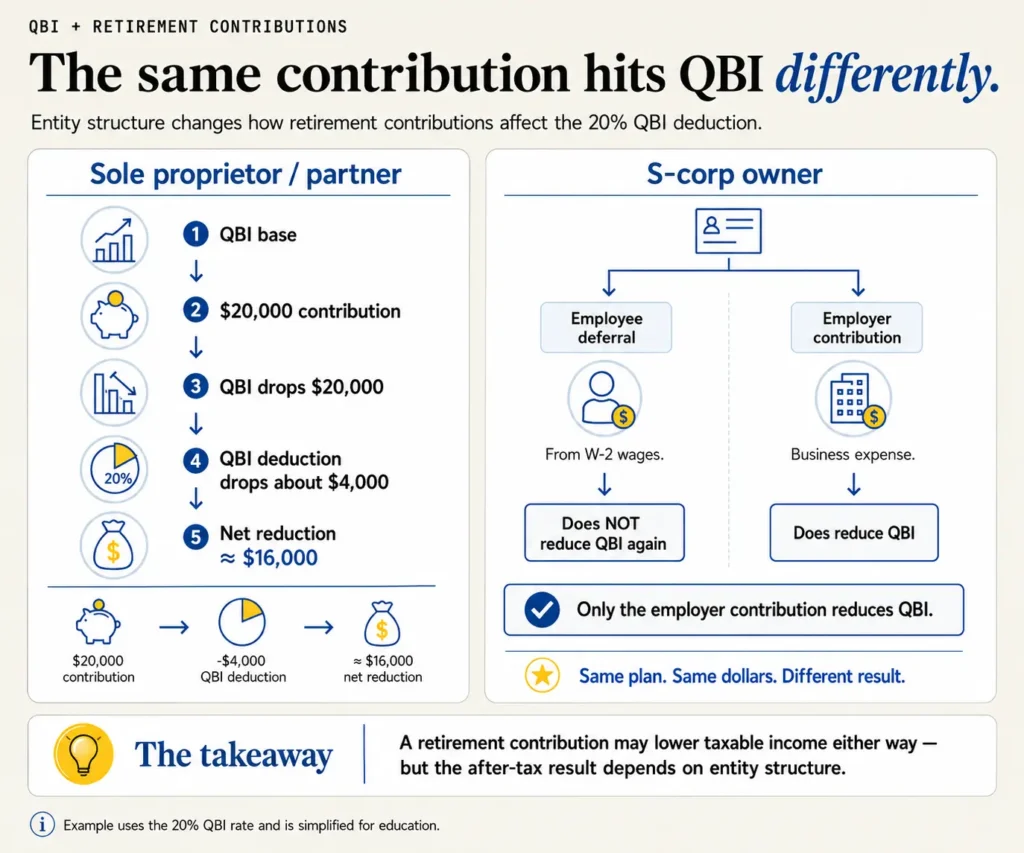
If you’re a sole proprietor or partner, contributions to your own retirement plan are subtracted in arriving at QBI. Every dollar contributed reduces your QBI deduction base by that same dollar. At the 20% rate, a $20,000 SEP or Solo 401(k) contribution is not a clean $20,000 write-off. It also costs roughly $4,000 of QBI deduction, so your taxable income falls by about $16,000, not $20,000.
If you’re an S-corp owner, the math splits. Your employee elective deferral comes out of W-2 wages, which are already excluded from QBI, so it does not reduce QBI a second time. Your employer contribution is a business expense and does reduce QBI. Same plan, same dollars, different result — which is exactly why entity structure has to be on the table when the contribution amount gets set.
That doesn’t make the contribution a bad idea. It means the real after-tax cost of maxing out a plan is different from what the contribution amount alone suggests. A preparer working from last year’s return, who never spoke to whoever set the contribution, won’t catch it until it’s too late to adjust.
One more reason this matters more in 2026 than it used to: the One Big Beautiful Bill Act made Section 199A permanent, removed the scheduled sunset, expanded the phase-in ranges, and added a minimum deduction. The QBI deduction is no longer a temporary provision you plan around loosely. It is a permanent feature worth optimizing every year.
A CPA focused only on “minimize this year’s return” and an advisor focused only on “maximize retirement assets” can each make a locally correct call that is wrong together. Coordination means the contribution amount, the entity structure, and the salary decision get set as one plan.
Which retirement plan should a business owner actually choose?
Four structures cover almost every business owner situation.
SEP-IRA
Employer-only contributions, up to 25% of compensation, capped by the annual compensation limit of $360,000 for 2026 and a maximum contribution of $72,000.
One wrinkle worth naming: for a sole proprietor, the “25%” is applied to net earnings after the SEP deduction itself, which works out to roughly 20% of net self-employment earnings before the deduction. For an S-corp owner it is a straight 25% of W-2 wages. Owners routinely overestimate the SEP ceiling because they apply 25% to the wrong number.
Simple to set up. No employee elective deferral, no catch-up contributions.
Solo 401(k)
Available to owners with no full-time employees other than a spouse. It allows two contributions:
- An employee elective deferral of $24,500 for 2026, plus a $8,000 catch-up at age 50 and over, or $11,250 for ages 60 through 63.
- An employer profit-sharing contribution of up to 25% of compensation.
The combined total is capped at $72,000 for 2026 — $80,000 including the standard catch-up, or $83,250 for ages 60 through 63.
That two-part structure is what lets a Solo 401(k) shelter more than a SEP-IRA at moderate income levels. At $100,000 of net earnings, a SEP caps out near $20,000. A Solo 401(k) can reach roughly $44,500 on the same income.
SIMPLE IRA
Lower administrative burden, lower ceiling. $17,000 in employee deferrals for 2026, or $18,100 for certain applicable small-employer SIMPLE plans, plus a required employer contribution — either a dollar-for-dollar match up to 3% of compensation or a 2% nonelective contribution for all eligible employees.
Rarely the right choice once a business can support a Solo 401(k) or SEP.
Cash-balance and defined-benefit plans
For owners past their peak saving years — typically mid-40s and up — who want to shelter far more than a 401(k) allows.
Contributions are actuarially calculated from age, income, and a target retirement benefit, and can run well into six figures annually. The ceiling is set indirectly by the annual benefit limit of $290,000 for 2026 under Section 415(b), which an actuary translates into a permitted contribution based on your age and years to retirement.
These plans require an actuary and a genuine multi-year funding commitment. They are not something to open casually the week before a filing deadline.
The 2026 numbers side by side
| Who it fits | 2026 maximum | NJ state treatment | |
|---|---|---|---|
| SEP-IRA | Simple setup, no employees or few | $72,000 | No NJ deferral |
| Solo 401(k) | Owner-only, wants maximum flexibility | $72,000 / $80,000 / $83,250 | Deferral excluded from NJ wages |
| SIMPLE IRA | Small team, minimal admin | $17,000 deferral + employer contribution | No NJ deferral |
| Cash-balance | High income, age 45+, stable cash flow | Actuarially determined | Varies by plan design |
The right plan depends on entity structure, income level, whether you have employees, and how many more years you plan to fund it. That is exactly why plan selection is a tax-and-retirement conversation, not a retirement-only one.
How does self-employment tax change your contribution ceiling?
If you’re a sole proprietor or a partner and not running payroll through an S-corp, your contribution capacity is based on net self-employment earnings — which is itself calculated after subtracting half of your self-employment tax.
For 2026, the Social Security portion applies at 12.4% on the first $184,500 of net self-employment income, plus 2.9% Medicare tax with no ceiling. Half of that self-employment tax is deductible above the line, and your SEP-IRA or Solo 401(k) limit is calculated on what remains — not on gross business profit.
Owners who estimate their ceiling off top-line revenue routinely overestimate what they can actually put in. It is a mistake we catch every year during plan-funding season.
S-corp owners diverge here in a way worth naming directly. An S-corp retirement contribution is based on your W-2 wage, which is not reduced by self-employment tax the way a sole proprietor’s net earnings are. S-corp distributions aren’t subject to self-employment tax at all — that is the point of the S-corp election. The math is different enough between the two structures that a contribution strategy built for one does not transfer cleanly to the other.
Does New Jersey tax retirement contributions the same way the IRS does?
No. This is one of the most consistently missed coordination points we see, because most owners — and more than a few preparers — assume state and federal treatment match.
New Jersey excludes 401(k) employee elective deferrals from state wages, the same way the federal government does. That treatment has applied since January 1, 1984 under N.J.S.A. 54A:6-21.
New Jersey does not extend that exclusion to other plan types. Per the NJ Division of Taxation’s own guidance on wages, the state does not allow you to exclude from wages amounts contributed to deferred compensation and retirement plans other than 401(k) plans — and it names 403(b), 457, 409A, 414(h), SEP, Federal Thrift Savings Funds, and IRAs specifically. The same guidance states that both employee and employer contributions to SIMPLE IRA, SEP, and SARSEP plans are included in New Jersey taxable wages.
New Jersey’s EGTRRA guidance confirms the underlying logic: only 401(k) contributions are specifically excluded from gross income under New Jersey law, so federal expansions to other plan types have no effect on New Jersey treatment.
What that means in practice. If you’re a sole proprietor funding a SEP-IRA instead of a Solo 401(k), the employer contribution reduces your federal taxable income but does nothing for your New Jersey taxable income in the year you contribute. Full federal benefit, zero state benefit.
A Solo 401(k) employee deferral, by contrast, gets you the state tax deferral a SEP-IRA cannot. For an owner near the top of New Jersey’s brackets, that asymmetry alone can be a meaningful argument for a Solo 401(k) over a SEP-IRA.
It is also a reason to keep permanent records of exactly how much New Jersey tax you have already paid on retirement contributions. That figure determines what is excludable when the money eventually comes out. A federally focused advisor unfamiliar with New Jersey’s carve-outs may never flag it.
What’s changing for 2026 that needs coordinating now?
Three federal changes affect business owners funding their own plans this year.
The “super catch-up” for ages 60 to 63 continues at $11,250, versus the standard $8,000 catch-up for ages 50 and up, for 401(k), 403(b), governmental 457, and Solo 401(k) plans. Both figures are confirmed in Notice 2025-67. This is a genuinely large opportunity for owners in that specific age band who are behind on savings and have the cash flow to fund it.
Mandatory Roth catch-up contributions begin in 2026 for higher earners. Anyone age 50 or older whose prior-year (2025) FICA wages from the plan sponsor exceeded $150,000 must make any catch-up contribution on a Roth after-tax basis rather than pre-tax. The threshold is in Notice 2025-67.
Two details matter here. The test looks at wages from the specific employer sponsoring the plan, not household income. And because it is wage-based rather than net-self-employment-income-based, it captures S-corp owners differently than sole proprietors without W-2 wages from the plan. This is a plan-design and payroll conversation for before year-end, not something to discover in April.
IRA and Roth limits increased again. The IRA limit rose to $7,500 with a $1,100 catch-up at 50 and over. The Roth IRA income phase-out moved to $153,000–$168,000 for single filers and $242,000–$252,000 for married filing jointly.
If your income sits near those thresholds, a small change in business income can push you across a boundary and change whether a direct Roth contribution is even available. That is why we watch projected business income during the year rather than only at filing time.
None of these are dramatic alone. Stacked with plan selection, S-corp salary, and state tax treatment, they are exactly the kind of detail that falls through the gap between a preparer who sees your return once a year and an advisor who sees your account but not your K-1.
When should your CPA and financial advisor actually talk?
Five moments are where siloed advice does the most damage.
When you first set up a plan. The plan you choose locks in a contribution structure that is expensive to unwind, particularly a cash-balance plan with its multi-year funding commitment. This decision should account for entity type, age, income trajectory, and state — not just what plan your broker happens to offer.
When you set or change your S-corp reasonable salary. Because the contribution ceiling is often a percentage of that salary, a payroll-tax-driven salary decision and a retirement-driven salary decision pull in opposite directions. The right number balances both.
When you’re deciding on a Roth conversion. A conversion adds to taxable income in the conversion year. It can push you into a higher bracket, reduce your QBI deduction, or move you across a Roth contribution phase-out threshold. Your CPA can see all of that coming from your business income projection before your advisor executes.
When required minimum distributions start. Under SECURE 2.0, RMDs generally begin at age 73 for anyone born 1951 through 1959, and age 75 for anyone born in 1960 or later. An RMD is forced ordinary income. It can push a retired owner into a higher bracket, change how much Social Security is taxable, and interact with income still coming from a sale note, consulting arrangement, or residual ownership. Coordinating the RMD amount with everything else on the return — rather than just satisfying the minimum — is where real tax is saved or lost.
In the year you sell or wind down the business. A large one-time gain changes every income-based phase-out and threshold above, often for that year only. Pre-funding contributions, timing a final SEP or Solo 401(k) contribution, and deciding whether to convert to a Roth in a lower-income year before or after the sale all need your CPA and advisor in the same conversation — ideally months before closing, not after.
What should a NJ business owner do next?
If your CPA and your financial advisor have never spoken about your account, that is the gap to close first. Not necessarily by changing either relationship — but by making sure the person who sets your contribution amount knows what your tax return needs, and the person who prepares your return knows what decisions are being made before they are final.
For most owners, plan selection and the salary question are the highest-leverage place to start, because they set the ceiling everything else operates under.
We coordinate both sides by design. Tax advisory and retirement planning are not separate service lines here. They are one conversation with one client file.
Book a retirement and tax coordination call
This article is general information for New Jersey business owners and is not individualized tax, legal, or investment advice. Contribution limits and thresholds are current as of the review date above and change annually. Your own situation depends on facts this article cannot know. Speak with a qualified professional before acting.
Sources
- IRS, Notice 2025-67 — 2026 cost-of-living adjustments for retirement plans — https://www.irs.gov/pub/irs-drop/n-25-67.pdf
- IRS, 401(k) limit increases to $24,500 for 2026, IRA limit increases to $7,500 (IR-2025-111) — https://www.irs.gov/newsroom/401k-limit-increases-to-24500-for-2026-ira-limit-increases-to-7500
- IRS, COLA increases for dollar limitations on benefits and contributions — https://www.irs.gov/retirement-plans/cola-increases-for-dollar-limitations-on-benefits-and-contributions
- IRS, Retirement topics — 401(k) and profit-sharing plan contribution limits — https://www.irs.gov/retirement-plans/plan-participant-employee/retirement-topics-401k-and-profit-sharing-plan-contribution-limits
- NJ Division of Taxation, NJ Income Tax — Wages — https://www.nj.gov/treasury/taxation/njit5.shtml
- NJ Division of Taxation, EGTRRA and Catch-up Contributions to Retirement Plans — https://www.nj.gov/njbonds/treasury/taxation/egtrra.shtml
- Congressional Research Service, Required Minimum Distribution Rules for Original Owners of Retirement Accounts (IF12750) — https://www.congress.gov/crs-product/IF12750
- Michael Kitces, The QBI Deduction-Reduction On Small Business Retirement Plan Contributions — https://www.kitces.com/blog/199a-qbi-deduction-reduction-small-business-owner-retirement-plan-contributions-roth/