A reasonable S-corp salary is what you’d have to pay someone else, with your training and workload, to do the job you actually do — priced against real comparable-wage data, not a round number or a percentage of profit. The IRS doesn’t publish a formula for it, but it has a published list of factors it uses to challenge a number it doesn’t believe, and two federal court decisions (both against the S-corp owner) show exactly how far short “too low” can leave you. Below, the factors, the math, and the process we actually run before a client’s first payroll check goes out.
What does “reasonable compensation” actually mean here?
Every S-corp shareholder who works in the business has to be paid a salary through payroll before any profit comes out as a distribution. The IRS’s standard, stated plainly on its own compensation guidance page, is what “would ordinarily be paid for like services by like enterprises under like circumstances.” That’s deliberately not a formula — it’s a market-rate test, and the IRS’s own framework for applying it starts by asking where the corporation’s gross receipts actually come from:
- The shareholder’s own services — the accounting work, the client calls, the actual production you personally provide.
- Non-shareholder employees — work other staff perform that isn’t yours.
- Capital and equipment — income the business throws off from assets, not labor.
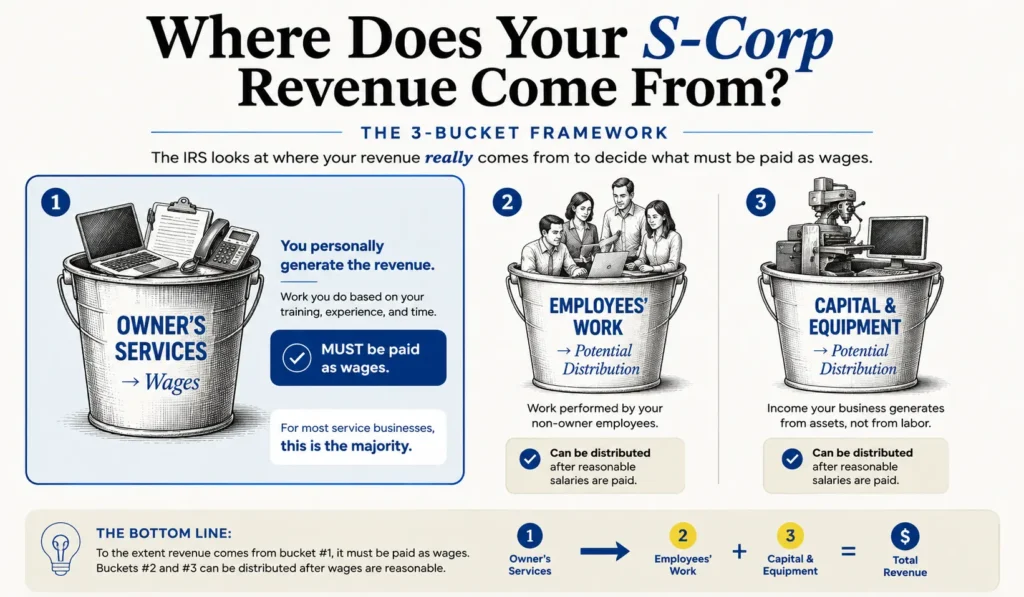
To the extent revenue comes from the first bucket, it has to be paid out as wages. To the extent it comes from the second and third, it can be distributed without payroll tax. Most single-owner service businesses — tax practices, consultancies, contractors, medical and legal practices — generate the overwhelming share of their receipts from bucket one, which is exactly why the IRS scrutinizes owner salaries in these businesses harder than in capital-heavy ones.
What factors does the IRS actually weigh?
The IRS’s published list, drawn from its S-corporation compensation guidance and the audit technique guide examiners use, includes:
- Training and experience. A 20-year CPA commands a different number than someone two years into practice.
- Duties and responsibilities. What you actually do — sales, delivery, management, administration — not your title.
- Time and effort devoted to the business. Full-time work supports a full-time number; a part-time role supports proportionally less.
- Dividend history. A pattern of large, regular distributions next to a token salary is the single biggest audit flag in this area.
- What the corporation pays non-shareholder employees for comparable work — if your staff earns more than you for similar duties, that’s a problem.
- Timing and manner of bonuses to key people.
- What comparable businesses pay for similar services — third-party wage data for the role, not internal opinion.
- Any compensation agreement already in place.
- Whether a formula was used to set the number, and whether that formula holds up.
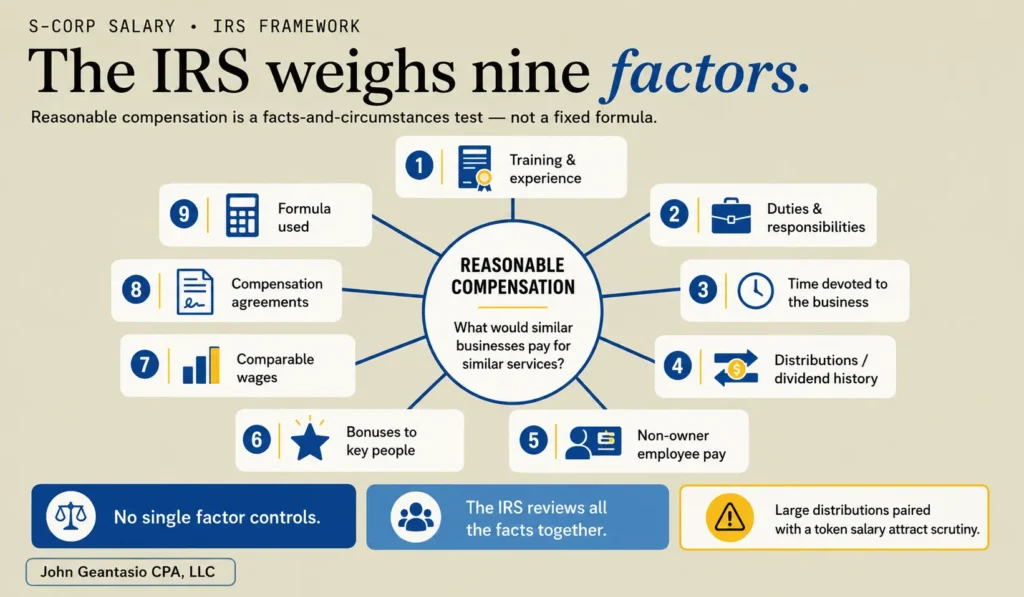
No single factor controls. A weak number on one axis (say, a below-market salary) can survive if the others are strong — but a business that scores poorly on several factors at once, especially “large distributions next to a token salary,” is the fact pattern the IRS has actually litigated and won.
What happened to the S-corp owners who got this wrong?
Two federal cases set the boundaries here, and both cases involved sole owners who tried to minimize salary and maximize distributions — precisely the instinct every new S-corp owner has to resist.
Watson v. United States (David E. Watson, P.C. v. United States, 668 F.3d 1008, 8th Cir. 2012): David Watson, a CPA and the sole shareholder, officer, and employee of his S-corp, paid himself a $24,000 salary in both 2002 and 2003 while the corporation distributed $203,651 and $175,470 to him in those same years. The IRS’s expert calculated $91,044 as the reasonable annual salary for someone with Watson’s 20 years of experience working 35–45 hours a week as a primary revenue producer at an established accounting firm. Both the district court and the Eighth Circuit sided with the IRS, recharacterizing the gap between $24,000 and $91,044 as wages and assessing FICA tax, interest, and penalties on it. The court’s language matters as much as the outcome: Watson’s stated “intent” to pay himself only $24,000 was “less than credible,” because intent doesn’t control — the economic reality of what the payments were actually for does.
Sean McAlary Ltd., Inc. v. Commissioner (T.C. Summary Op. 2013-62): A real estate broker who was the sole shareholder, worked 12-hour days, and generated $518,189 in gross receipts and $231,454 in net income paid himself zero salary and took a $240,000 distribution. The Tax Court set $83,200 as reasonable (based on a $40/hour market rate across a standard 2,080-hour work year), rejected the corporation’s own written compensation agreement because it wasn’t arm’s-length and wasn’t actually followed, and upheld separate penalties for failing to file payroll tax returns and failing to make timely payroll deposits — on top of the back FICA tax itself.
The pattern in both cases is the same: a real, credentialed, hard-working owner, a defensible-sounding business reason for keeping salary low, and a court that looked past stated intent to the comparable-wage evidence and ruled against the taxpayer. Neither owner was penalized for having an S-corp — both were penalized for pricing their own labor below what the market would actually pay for it.
How do we actually set the number for a client?
We don’t start from a percentage of profit or a round number — we start from the job itself, then check the answer against the IRS’s own factors.
- Define the actual role. What does the owner do day to day — production, sales, management, admin — and how many hours a week, realistically, across a full year (not a busy-season estimate)?
- Price the role against third-party market data, not an internal guess. Comparable-wage sources — Bureau of Labor Statistics occupational wage data for the specific role and geography, and paid reasonable-compensation reports built specifically for this purpose — are the same kind of evidence the IRS’s own expert used against Watson. If the IRS’s evidence in an audit would be a market-wage figure for your role, your defense needs to be built from the same kind of data before the audit, not after.
- Adjust for the specific business, not just the title. A solo CPA running a $1.2M practice with two staff supervises people and carries liability a solo bookkeeper doesn’t — that pushes the number up. A part-time owner who spends 15 hours a week on the business while a manager runs daily operations supports a lower number, proportional to actual time.
- Check it against the dividend pattern. If the plan is to take meaningful distributions on top of the salary, the salary has to be able to stand on its own against the factors above — a low salary next to a large distribution is the exact fact pattern in both Watson and McAlary.
- Document the reasoning, in writing, at the time the number is set — not reconstructed two years later during an audit. A short memo naming the role, the hours, the comparable-wage source, and the resulting figure is what turns a defensible number into a documented one.
- Revisit it when the business changes. Revenue growth, added staff, a shift in the owner’s actual duties, or a new line of service are all reasons to re-run the analysis — a number that was defensible three years ago at a different revenue level may not be defensible today.
Is there such a thing as setting the salary too high?
Yes — not from an IRS-challenge standpoint, but from a payroll-tax-efficiency standpoint, and it’s worth understanding both sides of the line. For 2026, combined Social Security and Medicare tax (FICA) is 15.3% of wages up to the Social Security wage base of $184,500 — 6.2% Social Security plus 1.45% Medicare, doubled for the employer and employee shares combined. Above that wage base, only the 2.9% combined Medicare portion continues to apply; the 12.4% Social Security portion stops entirely once wages cross $184,500 for the year. A salary set well above what the role and the market data actually support doesn’t just risk nothing from the IRS — it’s actively paying 12.4% Social Security tax on income that could have come out as a distribution instead, with no offsetting audit-defense benefit once you’re already well past what’s defensible for the role. If you’re a higher earner, the additional 0.9% Medicare surtax on wages above $200,000 (single) or $250,000 (married filing jointly) — a threshold that hasn’t moved since 2013 and isn’t adjusted for inflation — applies to salary and distributions differently, which is one more reason the number should be built from the job, not padded for comfort.
What actually happens if the IRS wins a reasonable-compensation challenge?
The exposure isn’t limited to the back FICA tax on the recharacterized amount. Based on how these cases have actually played out, a losing challenge typically brings: the employer and employee shares of FICA tax on the reclassified wages, interest running from the original due date, and — as in McAlary — separate penalties for failing to file the payroll tax returns (Form 941) that should have reported those wages and for failing to deposit the tax on time. A weak number doesn’t cost you the difference in tax; it costs you that difference plus interest plus penalties, assessed after the fact, usually several years after the return was filed.
What should you do next?
The number itself isn’t the hard part — the reasoning behind it is. If you already have an S-corp and can’t point to a written explanation for how the salary was set, that’s the gap worth closing before an audit ever asks the question, not after. If you’re deciding whether to elect S-corp status in the first place, the salary number is the input that determines whether the election is worth anything — see the revenue line where the S-corp election starts saving you money for how the two decisions connect.
Book a tax-planning consultation and we’ll build a documented, defensible salary number for your actual role — before payroll runs, not after an audit letter arrives.
Sources
- IRS, S corporation compensation and medical insurance issues (reasonable compensation factors, three sources of gross receipts) — https://www.irs.gov/businesses/small-businesses-self-employed/s-corporation-compensation-and-medical-insurance-issues
- IRS, S corporation employees, shareholders and corporate officers — https://www.irs.gov/businesses/small-businesses-self-employed/s-corporation-employees-shareholders-and-corporate-officers
- IRS Fact Sheet FS-2008-25, Wage Compensation for S Corporation Officers — https://www.irs.gov/pub/irs-news/fs-08-25.pdf
- Journal of Accountancy, “Eighth Circuit agrees that CPA was underpaid” (Watson case summary, $24,000 salary vs. $91,044 reasonable-comp figure) — https://www.journalofaccountancy.com/issues/2012/may/reasonable-compensation-may-2012/
- David E. Watson, P.C. v. United States, 668 F.3d 1008 (8th Cir. 2012) case summary — https://www.thetaxadviser.com/news/2012/feb/20120224/
- Sean McAlary Ltd., Inc. v. Commissioner, T.C. Summary Opinion 2013-62 — https://www.courtlistener.com/opinion/1037447/sean-mcalary-ltd-inc-v-commissioner/
- Social Security Administration, 2026 Cost-of-Living Adjustment Fact Sheet (2026 wage base $184,500) — https://www.ssa.gov/news/en/cola/factsheets/2026.html
- Thomson Reuters Tax & Accounting, SSA Announces Social Security Taxable Wage Base for 2026 — https://tax.thomsonreuters.com/news/ssa-announces-social-security-taxable-wage-base-for-2026/
- IRS Topic No. 560, Additional Medicare Tax (0.9% surtax thresholds, not indexed since 2013) — https://www.irs.gov/taxtopics/tc560
- IRS Topic No. 751, Social Security and Medicare withholding rates — https://www.irs.gov/taxtopics/tc751