
Key Takeaways
- Tax preparation and tax planning serve different purposes: preparation is reactive, while planning actively shapes future tax outcomes.
- Most business owners miss important planning opportunities that can lower their tax bills by only meeting their preparer once a year.
- Using a tax advisor for strategic year-round engagement usually saves money, especially when your tax situation has complexities.
- New tax laws reinforce the importance of planning as they offer permanent and valuable deductions effective 2026, making timely decisions critical.
- Understanding the distinction between tax preparers, accountants, and tax advisors can ensure you get the most value from your tax services in Spring Lake NJ.
Tax preparation and tax planning are not the same service, and the gap between them is where most business owners overpay. Preparation records what already happened and files it on time. Planning changes the number before the year closes — while you can still move income, time a purchase, set a salary, or pick a retirement plan. If you only meet your accountant once a year, in spring, you are buying the first service and missing the second. By the time a return is being prepared, almost every decision that could have lowered the bill is already locked.
This page explains the difference plainly, who actually needs a tax advisor versus a preparer, and why the line matters more in 2026 than it did a few years ago. It’s the hub for our tax-advisory work; the deeper how-to pieces (S-corp timing, reasonable salary, QBI, year-end moves) link out from here.
What is the difference between tax preparation and tax planning?
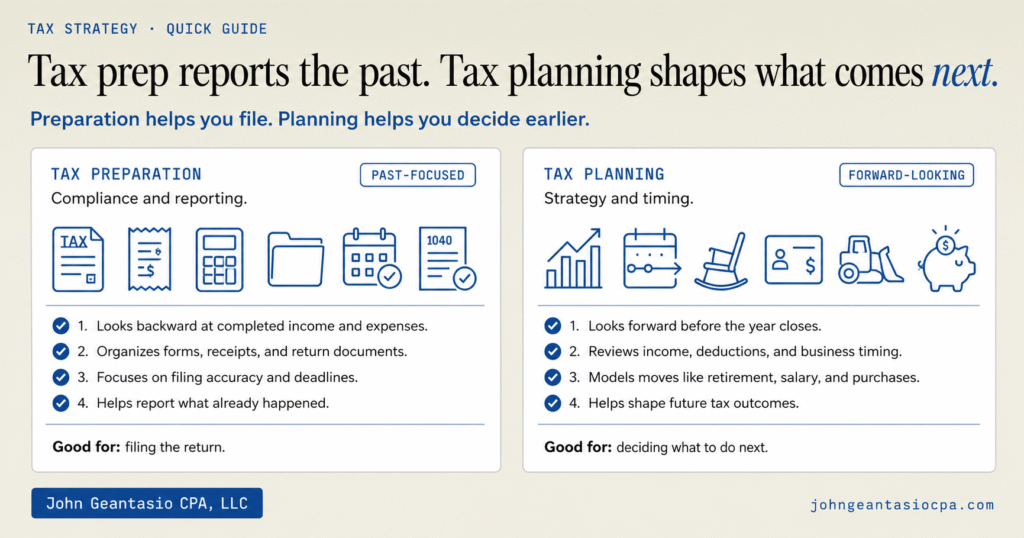
Tax preparation is compliance. A preparer takes the year that already happened — your income, expenses, and forms — and files an accurate return by the deadline. It reports the past.
Tax planning is strategy. It runs before deadlines, while outcomes can still change: timing income between years, timing equipment purchases against depreciation rules, choosing an entity structure, setting an owner’s salary, funding the right retirement plan, and projecting what you’ll owe so a large bill doesn’t surprise you. It shapes the future.
Both matter. They are two halves of one cycle, not competing options. The mistake is treating taxes as a once-a-year compliance task, because that quietly converts planning opportunities into missed ones. Industry guidance is blunt about the cost: blurring the two leads to reactive decisions and overpayments that, for many owners, run into five figures a year.
Tax preparer, accountant, or tax advisor — what’s the real distinction?
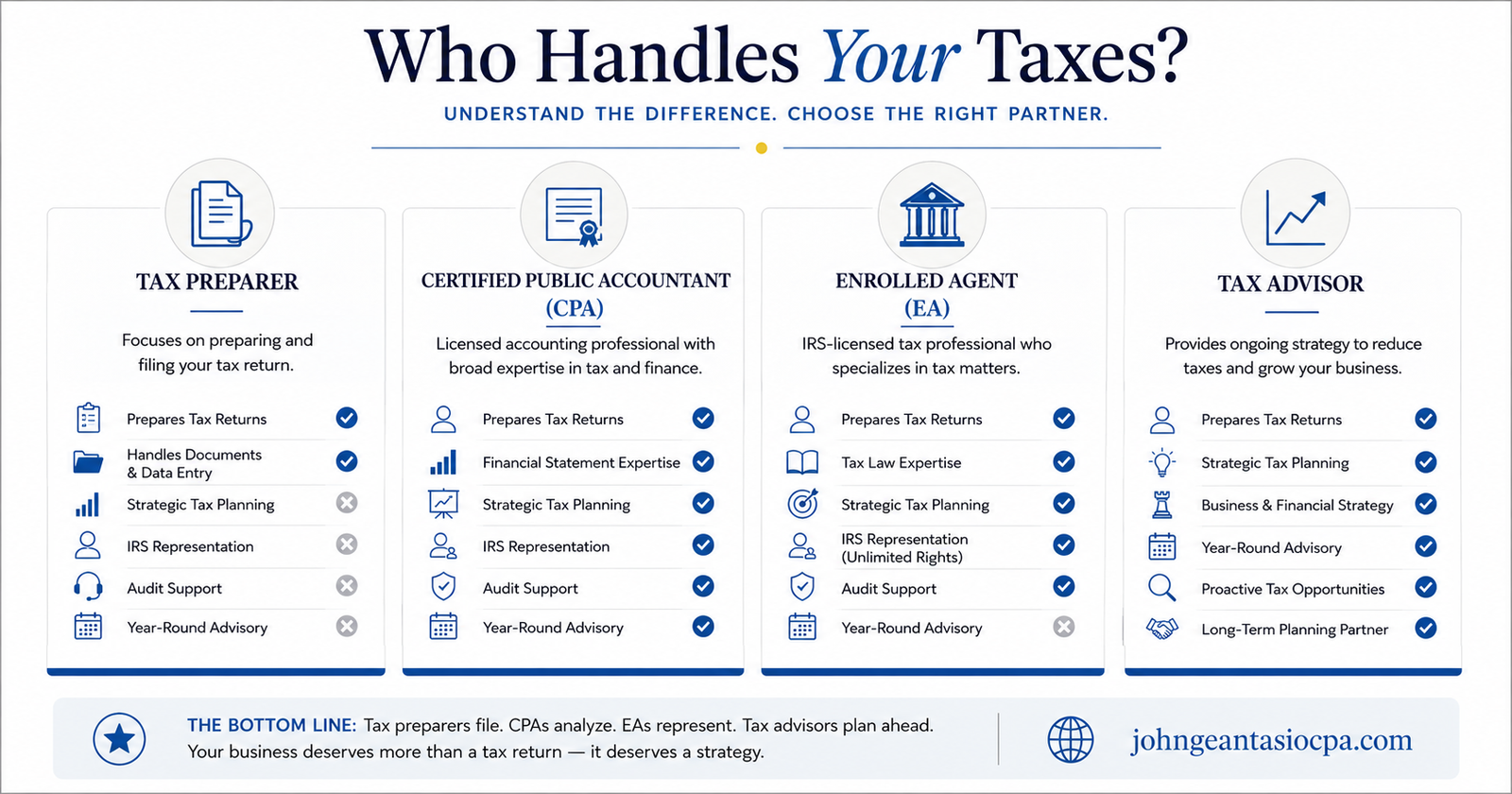
These titles get used loosely, so here’s what actually separates them.
A tax preparer is anyone the IRS authorizes to prepare returns for pay. The only federal requirement to do that is a valid Preparer Tax Identification Number (PTIN) — there is no mandatory exam, degree, or experience standard for a non-credentialed preparer. That’s not a knock on every preparer, but it’s the floor, and it’s worth knowing.
A credentialed professional — a CPA, an Enrolled Agent (EA), or a tax attorney — has met a real standard. CPAs complete accounting education, experience, and ongoing licensing requirements through their state board. EAs are licensed directly by the IRS after passing a three-part federal exam covering individual tax, business tax, and representation. The practical difference that matters most to you: CPAs, EAs, and attorneys have unlimited representation rights before the IRS. They can represent you in an audit, in collections, and in appeals — on any matter, not just a return they happened to file. A non-credentialed preparer generally can only deal with the IRS about the specific return they prepared, and nothing more complex.
A tax advisor describes a role, not a license. It means a professional who works with you year-round on strategy, not just at filing. An advisor is usually credentialed, but the defining trait is the engagement: they’re projecting, adjusting, and making moves with you across the year, not meeting you once with a shoebox of receipts in April.
Do I need a tax advisor, or is a preparer enough?
A preparer is enough when your situation is simple and stable: W-2 income, a standard deduction, maybe some interest, and few decisions to make. There’s nothing to plan, so paying for planning adds little.
You likely need an advisor once your taxes have levers — which is almost always true for business owners. Signs you’ve crossed the line:
- You own a business or are self-employed, so entity choice, owner compensation, and timing all affect the bill.
- Your income swings year to year, so multi-year timing matters.
- You’re making big moves: buying equipment, hiring, selling, buying real estate, or planning for retirement.
- You were surprised by your tax bill, or you’re making large estimated payments and aren’t sure they’re right.
- You have income near a threshold where a deduction phases in or out.
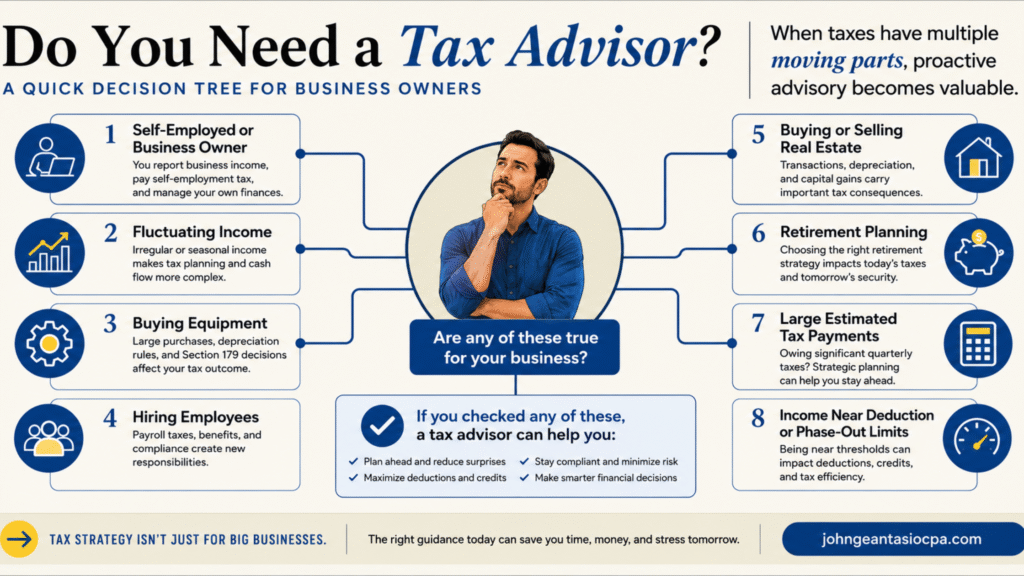
If two or more of those describe you, a year-round advisor will usually save more than they cost — not by finding loopholes, but by making ordinary decisions in the right order and at the right time.
Why does this distinction matter more in 2026?
Because the planning levers just got bigger and, for the first time in years, permanent. The One Big Beautiful Bill Act (OBBBA), signed into law on July 4, 2025, locked in several provisions that reward proactive planning:
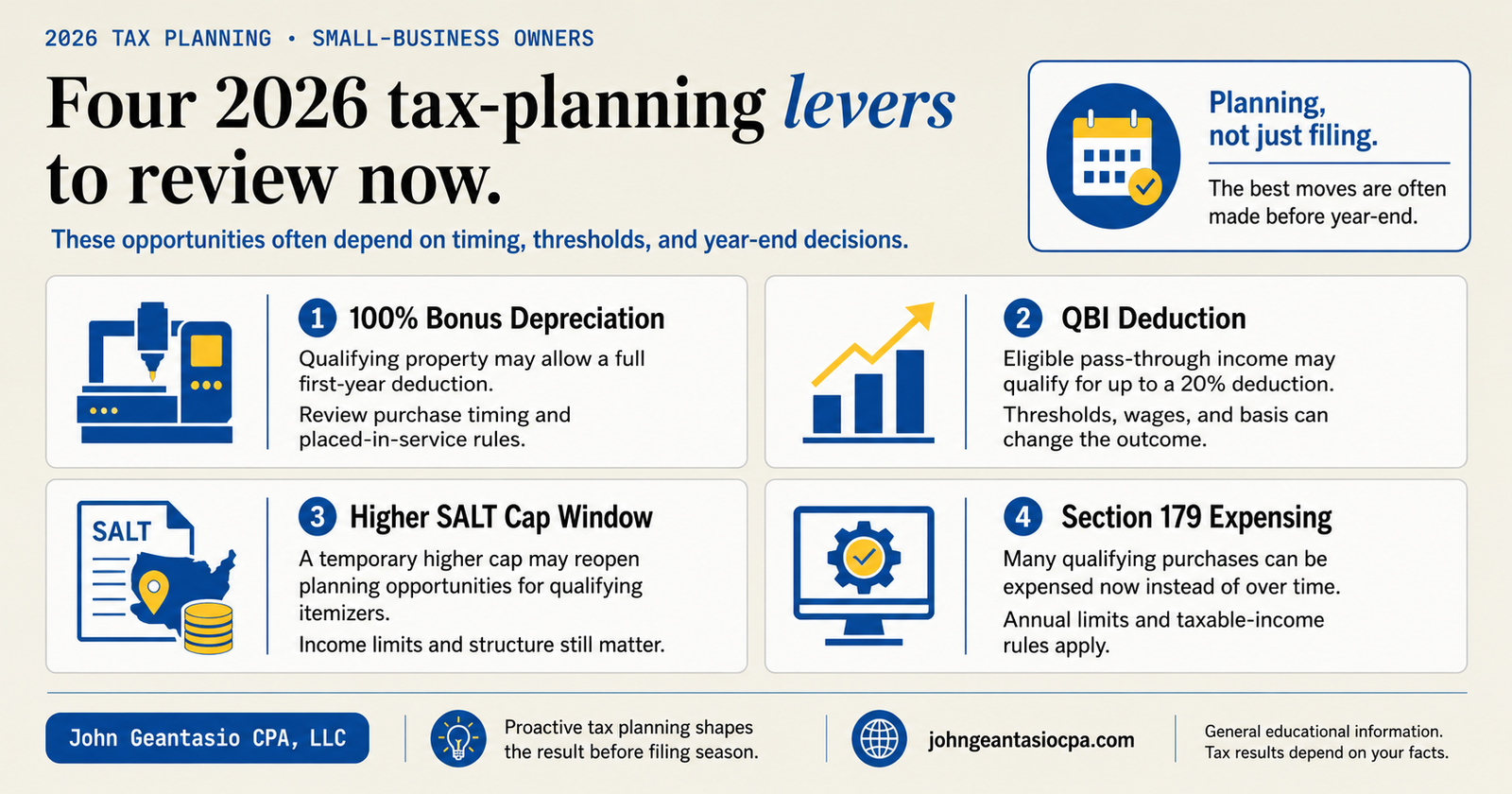
- 100% bonus depreciation is permanent again for qualifying property placed in service after January 19, 2025 — so the timing of an equipment purchase is once more a real, full-year-one write-off decision.
- The 20% Qualified Business Income (QBI) deduction is now permanent for pass-through owners, with the income phase-in thresholds raised starting in 2026 — meaning where your income sits, and how your entity is structured, directly affects how much of that deduction you keep.
- The SALT deduction cap rose from $10,000 to $40,000 for 2025 through 2029 (with small annual increases, then a scheduled drop back to $10,000 in 2030) — a five-year window that changes year-end decisions for higher-income New Jersey filers in particular.
- Section 179 expensing limits increased, widening the room to write off equipment immediately.
None of these help you if you only show up in April. A permanent 100% write-off does nothing for a machine you already bought in the wrong year. A higher SALT cap is a planning opportunity, not an automatic refund. The law made the tools more powerful; using them still requires deciding before the year ends. That’s the entire case for planning over preparation in 2026.
What to do next
If you only meet your accountant in spring, you’re getting half the service — the half that records the past, not the half that lowers the future. The fix isn’t dramatic; it’s a few short conversations across the year, at the points where a decision is still open. For a business owner with real levers — entity, salary, equipment, retirement, and now a richer set of permanent deductions to work with — that’s usually the difference between paying what you owe and paying more than you owe.
Book a tax-planning consultation
Sources
- IRS — Understanding tax return preparer credentials and qualifications — https://www.irs.gov/tax-professionals/understanding-tax-return-preparer-credentials-and-qualifications (accessed Jun 29, 2026)
- IRS — PTIN requirements for tax return preparers — https://www.irs.gov/tax-professionals/ptin-requirements-for-tax-return-preparers (accessed Jun 29, 2026)
- IRS — One Big Beautiful Bill provisions — https://www.irs.gov/newsroom/one-big-beautiful-bill-provisions (accessed Jun 29, 2026)
- Bloomberg Tax — Key tax changes for businesses from the OBBBA — https://pro.bloombergtax.com/insights/corporate-tax-planning/key-tax-changes-for-businesses-from-the-one-big-beautiful-bill-act-obbba/ (accessed Jun 29, 2026)
- Thomson Reuters — Upcoming tax law changes in 2026 — https://tax.thomsonreuters.com/blog/upcoming-tax-law-changes/ (accessed Jun 29, 2026)
- Brady Ware — Tax Preparation vs. Tax Planning — https://bradyware.com/tax-prep-vs-tax-planning/ (accessed Jun 29, 2026)