For most owners under about $5 million in revenue, the honest comparison is not “$60,000 salary vs. a $1,500 monthly fee.” Once you load an in-house bookkeeper with payroll taxes, benefits, software, and the cost of covering them when they’re out, a single full-charge hire in New Jersey runs roughly $66,000 a year stripped down and $80,000–$90,000 with benefits. Full-service outsourced accounting — what the profession calls Client Accounting Services, or CAS — typically runs $9,600–$30,000 a year for the same business and gives you a team instead of one person. The dollars usually favor outsourcing below mid-seven-figure revenue. The real decision is about volume, control, and risk, and that’s what this comparison walks through.
What’s the actual difference between a bookkeeper and outsourced accounting?
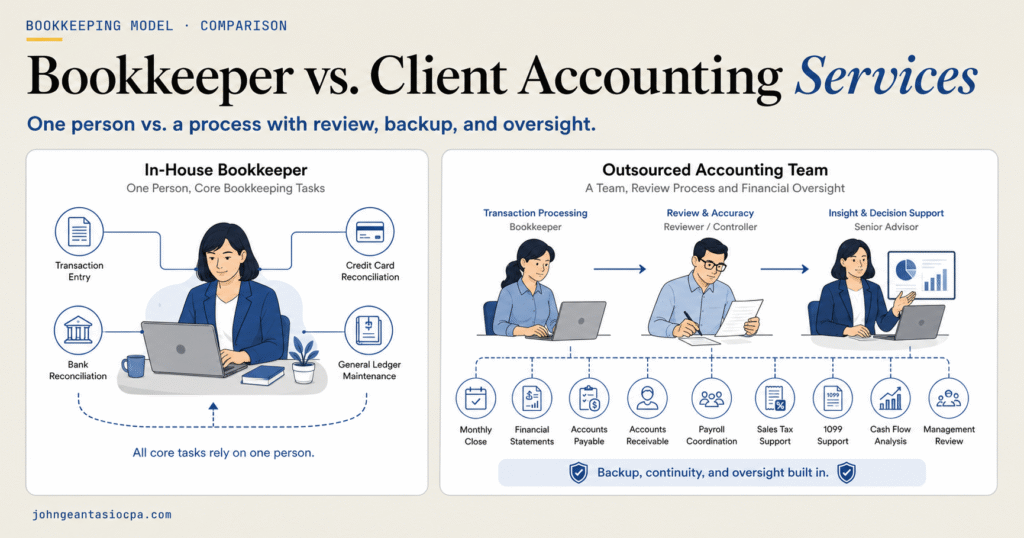
A bookkeeper records what already happened: enters transactions, reconciles bank and credit-card accounts, and keeps the ledger current. That’s necessary, and for a low-volume business it may be all you need.
Outsourced accounting (CAS) is a tier above that. A CAS engagement usually bundles the bookkeeping with a monthly close, financial statements you can actually read, payroll and bill-pay coordination, sales-tax and 1099 support, and — at the higher tiers — controller or fractional-CFO review that tells you what the numbers mean. Instead of one person doing data entry, you’re buying a small stack of roles: a bookkeeper for the daily work, a reviewer who catches errors, and senior oversight that connects the books to tax and cash decisions.
So the comparison isn’t one-to-one. A $60,000 bookkeeper buys you one person’s skill level. A $1,500-a-month CAS fee buys you a process with built-in review. Hold that in mind as we put numbers on each side.
What does an in-house bookkeeper really cost in New Jersey in 2026?
The salary is the part everyone sees. The other 25–45% is the part that surprises owners.
A full-charge bookkeeper in New Jersey averaged about $60,300 a year in 2026, with general bookkeepers closer to $47,500 and senior people reaching $67,800-plus (ZipRecruiter and Salary.com, May 2026). Monmouth County sits at the higher end of the state because of local wage pressure. Take a $60,000 hire as the working example and stack the employer costs on top:
- Employer Social Security: $3,720 — 6.2% on wages up to the 2026 base of $184,500 (IRS / SSA).
- Employer Medicare: $870 — 1.45%, no cap.
- Federal unemployment (FUTA): $42 — 0.6% net on the first $7,000 (IRS).
- NJ unemployment + workforce development: about $1,254 — a new employer pays 2.8% on the first $44,800 of wages in 2026; established employers fall anywhere from 0.5% to 5.8% (NJ Dept. of Labor & Workforce Development).
- NJ employer disability (TDI): roughly $135 — the employer rate runs 0.10%–0.75% on the same $44,800 base (NJ DOL). (New Jersey family-leave insurance is funded entirely by employee payroll deductions, so it costs the employer nothing.)
That’s about $6,020 in mandatory payroll taxes — roughly 10% on top of salary — bringing a $60,000 bookkeeper to about $66,000 before you’ve offered a single benefit.
Now add what it takes to keep a good one. Across U.S. private industry, benefits run about 30% of total compensation — health insurance, a retirement match, and paid time off (Bureau of Labor Statistics, Employer Costs for Employee Compensation, March 2026). You don’t have to offer all of it, but if you want to retain someone competent in this market, plan on another $8,000–$15,000. On top of that sit the costs that never make the spreadsheet: an accounting-software seat, continuing training, a workstation, recruiting time to fill the role, and the owner’s or office manager’s hours spent supervising the work.
Loaded honestly, a full-charge in-house bookkeeper in Monmouth County lands around $66,000 lean and $80,000–$90,000 with real benefits.
What does outsourced accounting (CAS) cost?
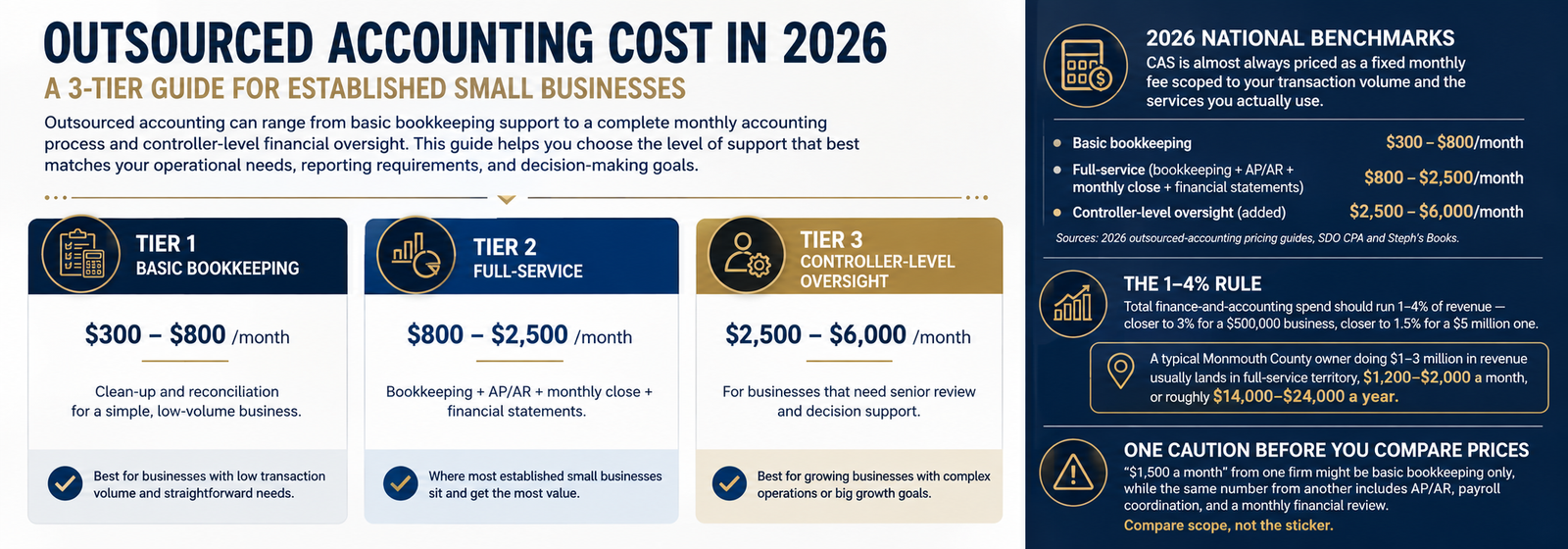
CAS is almost always priced as a fixed monthly fee scoped to your transaction volume and the services you actually use. National 2026 benchmarks land in three tiers:
- Basic bookkeeping: $300–$800/month — clean-up and reconciliation for a simple, low-volume business.
- Full-service (bookkeeping + AP/AR + monthly close + financial statements): $800–$2,500/month — where most established small businesses sit.
- Controller-level oversight: an added $2,500–$6,000/month — for businesses that need senior review and decision support.
(Sources: 2026 outsourced-accounting pricing guides, SDO CPA and Steph’s Books.)
A useful sanity check the profession uses: total finance-and-accounting spend should run 1–4% of revenue — closer to 3% for a $500,000 business, closer to 1.5% for a $5 million one. A typical Monmouth County owner doing $1–3 million in revenue usually lands in full-service territory, $1,200–$2,000 a month, or roughly $14,000–$24,000 a year.
One caution before you compare headline prices: “$1,500 a month” from one firm might be basic bookkeeping only, while the same number from another includes AP/AR, payroll coordination, and a monthly financial review. Compare scope, not the sticker.
So which one is actually cheaper?
For most owners under about $5 million in revenue who need one competent person’s worth of work but not a full 40 hours a week on site, CAS usually costs less fully-loaded and removes single-person risk at the same time. Put the two side by side for our $60,000-bookkeeper example:
- In-house, loaded: ~$66,000 lean / ~$80,000–$90,000 with benefits, plus software, training, and supervision time.
- Full-service CAS: ~$14,000–$24,000 for a comparable workload — and you’re not paying for idle hours, you don’t carry the payroll-tax and benefits overhead, and the work doesn’t stop when one person is sick or quits.
The dollars favor outsourcing for most businesses below mid-seven-figure revenue. The gap narrows — and can flip — when transaction volume is high enough to keep a full-time person genuinely busy.
When does an in-house bookkeeper actually make more sense?
Outsourcing is not the right answer for everyone. Hiring in-house tends to win when:
- Volume is high and constant. If the bookkeeping is genuinely a 40-hour-a-week job — heavy daily transactions, large AP/AR, multiple entities — a dedicated salary can cost less per hour than buying those same hours from a firm.
- The role is bigger than the books. When you need someone on site handling office management, vendor relationships, light HR, and customer billing alongside the ledger, that blended role is hard to outsource cleanly.
- You want direct, same-room control and have the management capacity to supervise, review, and cover the work when that person is out.
The catch with in-house is concentration: one person holds your entire financial record. If they make a quiet error, take it with them when they leave, or simply go on vacation during close, you feel it. That single-person risk is the cost that doesn’t show up until it does.
What hidden costs do owners miss on each side?
On the in-house side: payroll taxes (~10%), benefits to retain talent (often 15–30% more), software seats, training, recruiting, supervision time, and the coverage gap when the role turns over. A bookkeeper who leaves mid-year can cost weeks of cleanup before the next one is productive.
On the outsourced side: scope creep if responsibilities aren’t defined, the ramp-up of onboarding messy books (often a one-time cleanup fee), and less day-to-day control if you’re used to walking over to someone’s desk. A good CAS engagement manages these with a clear scope, a defined monthly close, and a named point of contact.
How should a Monmouth County owner decide?
Start with three honest questions: How many hours of bookkeeping does your business actually generate each week? Do you need someone for the books only, or for a broader on-site role? And do you have the management capacity to supervise and back up an in-house hire?
If the work is part-time, the role is the books, and you’d rather not carry payroll overhead or single-person risk, outsourced accounting almost always delivers more capability per dollar below $5 million in revenue. If the work is a genuine full-time job that bleeds into operations, in-house may earn its keep. The right answer is the one that matches your volume, not the one with the lower sticker price — and that’s the comparison we run, with your real numbers, in a books-and-CAS assessment.
Book a books-and-CAS assessment, and we’ll run the true-cost comparison on your actual numbers.
Sources
- 2026 Payroll Tax Guide: Social Security Wage Bases & FICA Rates — https://bsi.com/2026-payroll-tax-rates-updated-social-security-wage-bases-and-fica-rates/
- IRS, Topic No. 751 / FUTA and FICA rates (2026) — https://www.irs.gov/pub/irs-pdf/p926.pdf
- NJ Dept. of Labor & Workforce Development — New Benefit Rates for 2026 — https://www.nj.gov/labor/lwdhome/press/2025/20251229_newbenefitrates2026.shtml
- NJ Division of Employer Accounts — Rate information, contributions, and due dates — https://www.nj.gov/labor/ea/employer-services/rate-info/
- NJ 2026 Disability & Family Leave (TDI/FLI) contribution rates — https://www.prudential.com/legislative-monitor-issue/NJ-2026-changes
- Bureau of Labor Statistics — Employer Costs for Employee Compensation, March 2026 — https://www.bls.gov/news.release/ecec.nr0.htm
- Bookkeeper Salary in New Jersey (2026), Salary.com — https://www.salary.com/research/salary/benchmark/bookkeeper-salary/nj
- Full Charge Bookkeeper Salary in New Jersey (2026), ZipRecruiter — https://www.ziprecruiter.com/Salaries/Full-Charge-Bookkeeper-Salary–in-New-Jersey
- Outsourced Accounting Cost Guide 2026, SDO CPA — https://www.sdocpa.com/outsourced-accounting-cost/
- How Much Does Outsourced Bookkeeping Cost in 2026, Steph’s Books — https://stephsbooks.com/blog/outsourced-bookkeeping-cost