
The tax problem Dover business owners usually see too late
If you run a business in Dover, the problem is rarely that you are not making money. The problem is that too much of that money disappears before it has a chance to build anything meaningful. Revenue rises, the business gets heavier, and the tax bill grows with it. By the time you sit down to review the numbers, the year has already told its story.
That is why choosing the best CPA in Dover is not really about finding someone who can prepare a return accurately. Accuracy matters, but it is the minimum standard, not the winning difference. The real difference is whether the person advising you can influence the year before it closes. In Delaware, where many owners assume a business-friendly environment automatically protects them, that misunderstanding can get expensive. A favorable legal environment does not create a tax strategy on its own. Someone still has to design it.
That is where most business owners begin losing money quietly, and once you understand that, the next question becomes unavoidable: why does this happen even to smart owners who are doing everything else right?
Why Dover business owners overpay
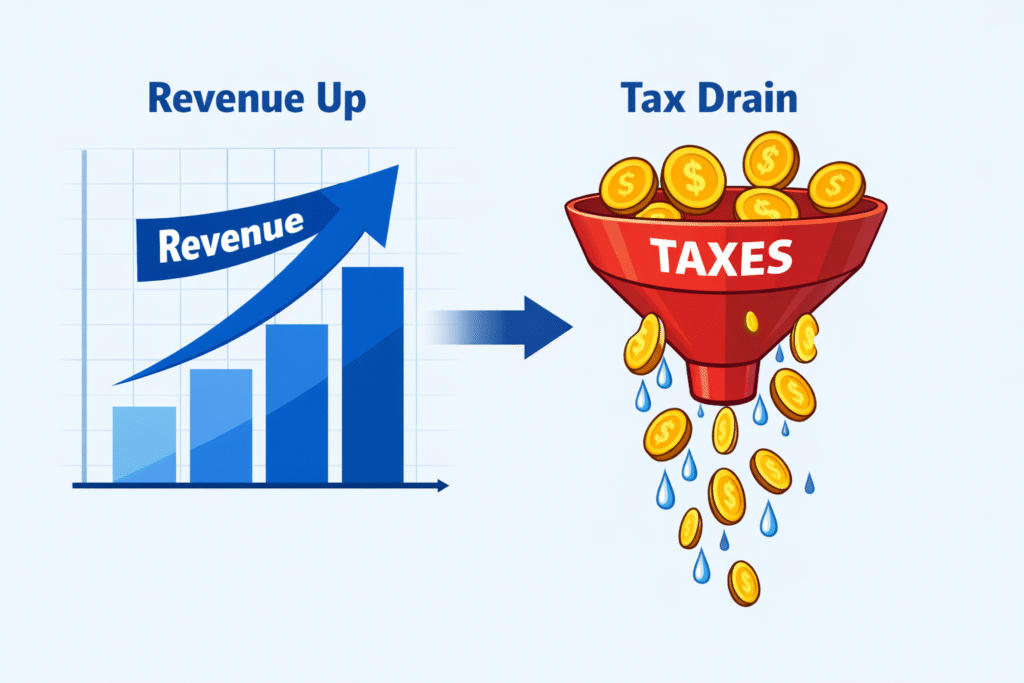
Most Dover business owners do not overpay because they are careless. They overpay because their business grows while their tax structure stays frozen. The LLC they formed years ago remains untouched. The way they take income never gets re-examined. The money comes in, gets categorized the same way it always has, and the tax bill rises right along with it.
Take a common example. A business owner earning $400,000 through a default sole proprietorship may be exposing too much of that income to self-employment tax and ordinary income treatment simply because nobody reviewed whether the structure still made sense. The return can still be prepared correctly. But correct reporting of a bad setup does not make the setup any less expensive.
This is where many owners confuse a clean filing process with good financial management. They assume that because nothing is technically wrong, nothing is strategically wrong. That assumption is costly. And it leads directly to the next issue: what a strong CPA actually does differently.
What the best CPA in Dover actually changes
A strong CPA does not begin with forms. A strong CPA begins with decisions. They want to know how your income is earned, how it flows through the business, how much is being pulled out personally, and whether those patterns still match your current level of profit. Instead of waiting for the year to finish and then describing the damage, they work upstream while the outcome can still change.
That is where John becomes relevant in a practical way. When a business owner comes to John earning around $400,000 a year under a sole proprietor setup, he does not start by searching for another minor deduction. He starts by measuring how much of that income is being taxed more heavily than necessary because the structure never evolved as the business grew. Then he looks at whether an S corporation election should be considered, how compensation should be split, and whether profits are being taken in the most tax-efficient way.
That is not abstract strategy language. It is a concrete difference in method. One advisor documents what happened. The other identifies what is making the result more expensive than it needs to be. And once that becomes clear, the conversation naturally gets bigger than taxes alone.
The bigger goal is not just tax savings
A business owner who saves money on taxes but does nothing useful with the savings has improved a number, but not necessarily their life. The bigger goal is to turn tax efficiency into asset growth. That is where tax strategy becomes wealth strategy.
The framework behind that idea is simple. Instead of allowing every extra dollar to pass through the highest-friction tax path, you redirect part of that money into assets that compound over time. The source material you shared makes this point clearly: real tax planning is about moving tax liabilities into assets and using the tax code to build wealth over time, not just finding missed deductions at filing season .
That is why the right CPA is not simply a return preparer with credentials. At a high level, a tax planner works more like a combination of accountant, financial advisor, and business consultant, helping clients shift saved tax dollars into long-term asset building .
That is the doorway into the idea many owners remember once it is explained well: the financial fortress.
What a financial fortress actually means
A financial fortress is not a slogan. It is a useful way to describe what happens when tax planning is connected to long-term asset building. The foundation is lower tax drag. The walls are the assets built with money that would otherwise have left the business unnecessarily. The protection comes from the fact that those assets can produce value outside your day-to-day effort.
In practical terms, that could mean a Dover business owner reduces unnecessary tax exposure through better entity planning, then redirects some of that retained cash into retirement accounts, real estate, or investment assets that appreciate over time. The wealth comes gradually, through assets that grow faster than inflation and may also create rents, dividends, royalties, or depreciation benefits along the way, which is exactly the broader tax-planning principle outlined in the book you shared .
When explained this way, the financial fortress concept stops sounding dramatic and starts sounding operational. It becomes a sequence. First, reduce unnecessary tax friction. Second, keep more cash in the system. Third, move that cash into assets that strengthen your future position. That sequence is what most owners are missing.
And once you see that, the next question is not “Do I need a CPA?” It is “Is my current CPA helping me build this, or simply helping me report around its absence?”
How to tell whether your current CPA is enough
You can usually answer that by looking at when the important conversations happen. If your CPA mainly speaks with you when tax season is already underway, the relationship is probably compliance-centered. That is not useless, but it is limited. If the only value you receive is after-the-fact explanation, you are paying for reporting, not direction.
A more strategic relationship sounds different. You discuss income growth while the year is still in motion. You review entity structure before another twelve months pass under the same setup. You talk about timing, compensation, profit retention, and what should happen before major decisions are finalized. The service becomes more involved because the consequences are more meaningful.
The book makes an important point here as well: tax planning is a higher level of service than tax preparation because strategies can work against one another, and choosing the right combination requires interpretation, timing, and coordination rather than simple reporting .
That is why the best CPA in Dover is not the one who simply knows the rules. It is the one who knows which rules matter most for your business before time removes your options.
Frequently asked questions
What makes a CPA the best in Dover, Delaware?
The best CPA in Dover is the one who changes financial outcomes before they become fixed. Filing correctly is important, but that is the baseline, not the differentiator. What separates a strong advisor is the ability to identify how your income is being taxed, where the structure is failing you, and what should change before year-end. For example, if an owner is earning $400,000 under an outdated setup, the best CPA does not just file around that fact; they show what structural changes may alter the result. The practical difference is that the client leaves with a better plan, not just a completed return.
Do I need tax planning if my taxes are already being filed correctly?
Yes, because filing correctly and planning intelligently are two different services. Filing reports what already happened. Planning influences what happens while you still have the power to change it. A business owner can have a perfectly accurate return and still overpay significantly if entity design, timing, and compensation decisions were never reviewed in time. That is why so many owners feel frustrated after a “clean” filing season. The return may be accurate, but the year it reflects may have been unnecessarily expensive.
Is this only relevant for very high-income business owners?
No, but the impact becomes easier to see as income rises. A business owner earning $100,000 has fewer strategic levers than someone earning $300,000 or $500,000, but both still benefit from getting structure and timing right. For example, the wrong setup at $100,000 may be tolerable for a while, but at $400,000 it can become a major source of leakage. The higher the income, the more visible the cost of inaction becomes. That is why many owners only notice the issue once they have already overpaid for several years.
What changes when someone works with John instead of staying reactive?
The biggest change is that decisions start getting reviewed before they harden into consequences. John looks at the way money moves through the business, how much tax friction is being created by the current structure, and what should be adjusted while the year is still live. For instance, when he sees a business owner earning high income under a sole proprietor setup, he does not treat that as a neutral fact; he treats it as a planning question that may need immediate correction. That changes the relationship from passive reporting to active guidance. Over time, the owner gains not just lower taxes, but more control over how retained money is used to build long-term wealth.
What to do next
If you are a business owner in Dover and you have the feeling that too much of your income is disappearing before it builds anything real, that feeling is probably pointing to a structural problem. Working with John means those decisions get reviewed while they can still change the outcome, not after the year has already become a tax return.
You do not need another explanation after the damage is done. You need a better design before this year closes.
Book a tax strategy session with John and find out what your current setup is costing you now.