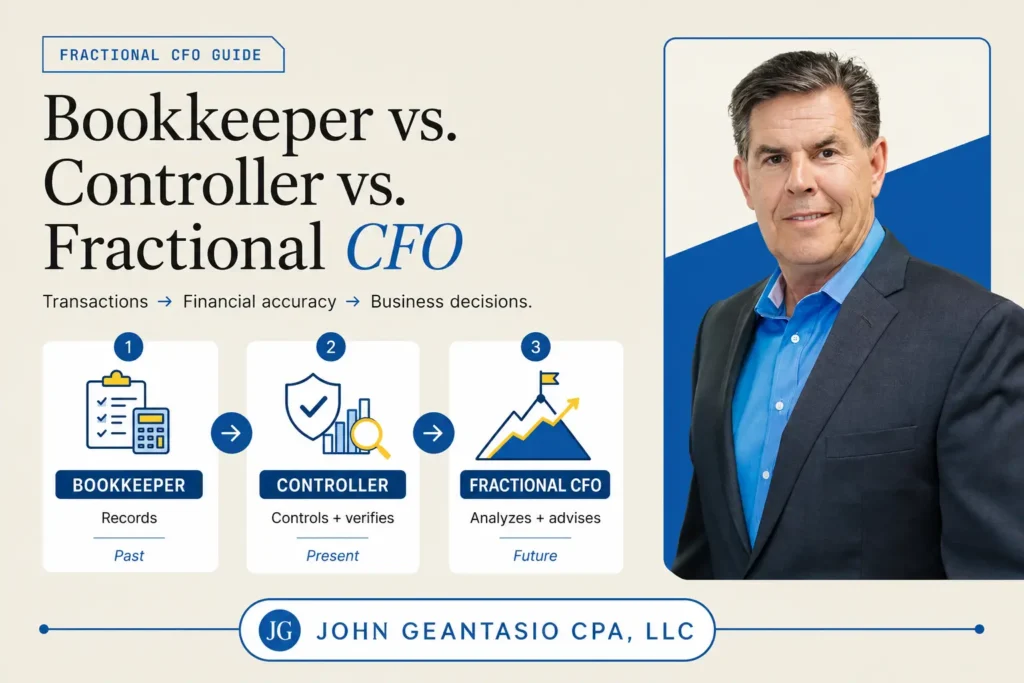
A bookkeeper records what already happened. A controller makes sure those records are accurate, timely, and controlled. A fractional CFO uses those accurate records to tell you what to do next. Most Monmouth County business owners have the first role, sometimes have the second, and almost never have the third — which is exactly why the business can have “good books” and still be flying blind on cash, pricing, and growth decisions. If you’re trying to figure out which one your business actually needs, the honest answer for most owners under $10M in revenue is: you need bookkeeping done well, and you need CFO-level thinking applied periodically — you very rarely need a full-time controller in between.
What does each role actually do, day to day?
| Comparison | Bookkeeper | Controller | Fractional CFO |
|---|---|---|---|
| Primary focus | Transactions | Accounting system | Business decisions |
| Time horizon | Past | Past + present | Future |
| Main responsibility | Recording accurately | Ensuring accounting accuracy and control | Using financial data to guide decisions |
| Typical work | Reconciliations, AP/AR, payroll, categorization | Close, controls, compliance, team oversight | Forecasting, pricing, scenarios, capital planning |
| Main output | P&L and balance sheet | Accurate and timely financial close | Recommendation / financial decision |
| Core question | “What happened?” | “Are the numbers right?” | “What should we do next?” |
| Strategic level | Operational | Managerial | Strategic |
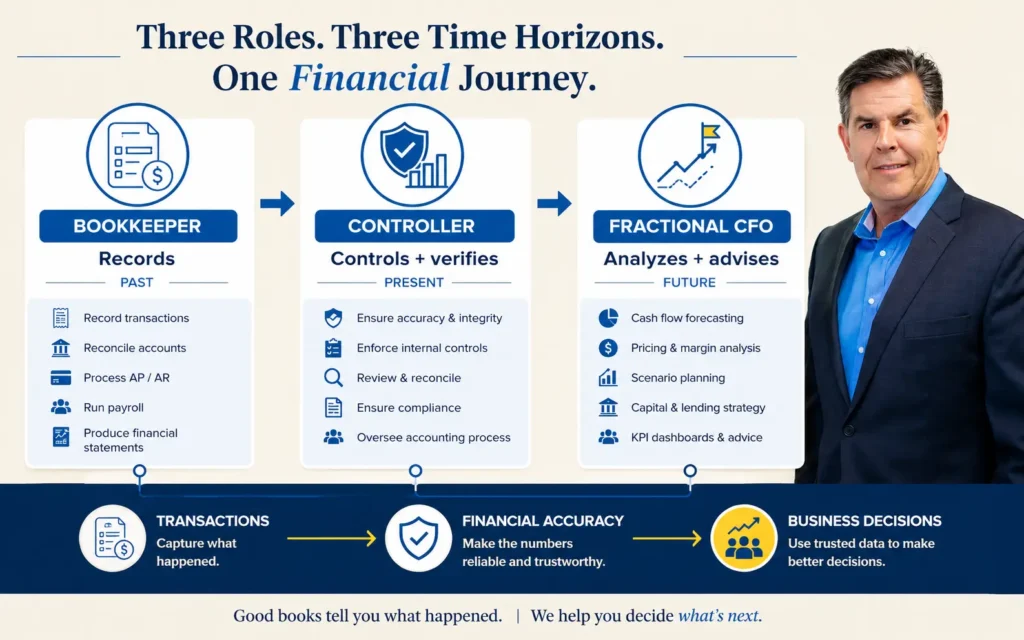
Bookkeeper. Records transactions. Categorizes expenses, reconciles bank and credit card accounts, processes accounts payable and receivable, runs payroll if that’s in scope, and produces basic financial statements — a profit and loss and a balance sheet. The bookkeeper’s job is accuracy of the past: what came in, what went out, what’s owed. A competent bookkeeper closes your books monthly and hands you numbers you can trust are complete.
Controller. Owns the accounting function, not just the transactions. A controller designs and enforces the internal controls that keep a bookkeeper’s work correct — segregation of duties, approval workflows, reconciliation review, close checklists. Controllers manage the month-end and year-end close process, prepare GAAP-compliant financials, oversee compliance (sales tax, 1099s, multi-entity consolidation), and often supervise bookkeeping staff. Where a bookkeeper asks “did I record this correctly,” a controller asks “is our whole accounting process correct, and can I prove it.” Controllers are backward- and present-looking: their job is that the numbers are right, not what to do about them.
What is a Fractional CFO?
Fractional CFO. Forward-looking and decision-focused. A fractional CFO takes accurate financials — whether produced by your bookkeeper, controller, or CAS team — and turns them into cash-flow forecasts, pricing and margin analysis, scenario planning, capital allocation decisions, banking and lending relationships, KPI dashboards, and the financial narrative you’d bring to a partner, a bank, or a buyer. A CFO doesn’t record the transaction or design the control around it — a CFO uses the output to answer “where is this business going, and what do we do about it.” The role is strategic and part-time by design: most businesses under $20-30M in revenue don’t have enough CFO-level work to justify a full-time seat, which is the entire premise of “fractional.”
The confusion happens because all three roles touch “the numbers.” The distinction isn’t subject matter — it’s time horizon. Bookkeeper looks backward at transactions. Controller looks at the present accuracy of the whole system. CFO looks forward at what the numbers mean for your next decision.
Fractional CFO vs. controller: what’s actually different?
This is the comparison that trips up the most owners, because both roles sound senior and both cost real money. The practical differences:
Scope. A controller’s scope is the accounting department — closing the books correctly, keeping compliance current, managing the team that does data entry and reconciliation. A CFO’s scope is the whole business — pricing, hiring plans, cash runway, debt structure, whether a location or product line is actually profitable once you allocate overhead correctly.
Deliverable. A controller’s deliverable is a clean, accurate, timely close. A CFO’s deliverable is a decision or a recommendation — should you take the equipment loan, can you afford the two hires you’re planning for Q1, why does the P&L show a profit while the bank account is empty.
Employment model. Controllers are almost always full-time employees, because the close-and-controls work is a constant, ongoing workload regardless of company size. CFO-level strategic work tends to come in bursts — a forecast built quarterly, a board or lender package prepared monthly, a pricing review done twice a year — which is why the fractional model (a set number of hours or a defined monthly scope, not a full-time seat) fits most businesses under roughly $10-20M in revenue far better than a full-time hire.
Cost. A full-time controller in a small business runs roughly $85,000-$130,000 in base salary nationally as of 2026, with the middle of the range around $109,000 — before payroll taxes, benefits, and overhead, which typically add another 20-30% (Salary.com, ZipRecruiter). A fractional CFO engagement for a business under $5M in revenue typically runs $3,000-$5,000 a month; for a business in the $5M-$50M range, $5,000-$10,000 a month is the common band (Eightx, CFO Advisors). A full-time CFO, by contrast, is a different order of cost entirely: for companies under $50M in revenue, base salary alone typically runs $170,000-$230,000, with total cash compensation (including bonus) often landing between $200,000 and $300,000 once benefits are added (Workday, SalaryCube). Most businesses in that revenue range have real CFO-level questions — but not enough of them, every week, to justify that full-time cost.
What does a fractional CFO actually do that a bookkeeper or controller doesn’t?
Concretely, a fractional CFO engagement typically includes some combination of:
- Cash-flow forecasting — usually a rolling 13-week forecast, so you can see a cash gap coming weeks before it happens rather than discovering it in the bank balance.
- Margin and pricing analysis — breaking profitability down by service line, product, job, or client, because an aggregate P&L can show an overall profit while individual lines are quietly losing money.
- KPI dashboards — a small set of numbers (not everything QuickBooks can generate) that tell you, at a glance, whether the business is on track.
- Scenario and capital planning — modeling the financial effect of a hire, a lease, a loan, or an acquisition before you commit to it.
- Banking and lending relationships — preparing the financial package a bank or SBA lender wants to see, and representing the business in those conversations.
- Budgeting — building next year’s plan with the owner in Q4, so January starts with a target instead of a guess.
- Board, partner, or exit-prep reporting — translating the financials into the narrative an outside party needs to make a decision about the business.
None of this replaces bookkeeping or controller-level accounting — it depends on it. A CFO working from inaccurate books produces an inaccurate forecast. That’s why the sequence matters: get the bookkeeping right first, add controller-level process once the transaction volume genuinely requires it, and layer in fractional CFO work once the business has decisions complex enough to need forward planning, not just accurate history.
Can one person do all three roles?
In practice, this is what happens at almost every business before roughly $2-3M in revenue: the owner, an outsourced bookkeeper, or a bookkeeper/office manager hybrid handles transaction recording, and the owner personally does the “CFO thinking” — often without realizing that’s the role they’re filling, and often without the tools (forecast, dashboard, margin analysis) that would make those decisions easier and less anxious. This works until it doesn’t. The usual failure point is when the owner is making six-figure decisions — a hire, a lease, a loan, an equipment purchase — off gut feel and a bank balance, because nobody is producing the forward-looking numbers that should be informing the call. That’s the gap fractional CFO work is built to close, and it’s almost always cheaper than the cost of the wrong decision it prevents.
A controller becomes necessary — as a distinct hire from a bookkeeper — once transaction volume, entity complexity (multiple locations, multiple entities, inventory, multi-state sales tax), or compliance risk outgrows what a bookkeeper can reliably manage alone. For most businesses under roughly $5-10M in revenue, an outsourced CAS (client accounting services) team can perform controller-level oversight without the business carrying a full-time controller salary — which is a separate comparison worth understanding on its own.
Which one do I actually need right now?
A rough diagnostic, not a hard rule:
If your books are inconsistent, late, or you don’t trust the numbers — start with bookkeeping. Nothing above that layer works without accurate transactions.
If your books are accurate but you’re spending your own time on reconciliations, close, compliance, or managing bookkeeping staff — you likely need controller-level oversight, which for most businesses under $5-10M is more cost-effective through an outsourced CAS arrangement than a full-time hire.
If your books are accurate and current, but you’re still guessing on cash runway, pricing, hiring timing, or whether a decision is affordable — that’s a fractional CFO gap, not an accounting gap. More bookkeeping or a full-time controller won’t fix it; forward-looking analysis will.
So which do you actually need?
Most owners reading this already have the answer once the roles are laid out: either the books aren’t trustworthy yet (fix that first), or the books are fine but nobody is doing anything with them beyond the tax return (that’s the fractional CFO gap). Very few businesses under $10M in revenue need a full-time controller as a separate hire from a strong bookkeeping or CAS relationship — the math almost never works until transaction volume or compliance complexity forces it.
The fastest way to find out where your business actually sits is a short conversation about what decisions you’re making without the numbers to back them up.
Book a fractional-CFO discovery call to find the best solution for your business.
Sources
- Small Business Controller Salary — Salary.com — https://www.salary.com/research/salary/position/small-business-controller-salary (accessed 2026-07-03)
- Small Business Controller Salary — ZipRecruiter — https://www.ziprecruiter.com/Salaries/Small-Business-Controller-Salary (accessed 2026-07-03)
- Fractional CFO Cost 2026: Pricing Guide — Eightx — https://eightx.co/blog/fractional-cfo-cost-pricing-guide (accessed 2026-07-03)
- Fractional CFO Pricing 2026: What Series A SaaS Startups Actually Pay — CFO Advisors — https://cfoadvisors.com/blog/fractional-cfo-pricing-2026-series-a (accessed 2026-07-03)
- The Definitive 2026 CFO Salary Guide — Workday — https://www.workday.com/en-us/perspectives/finance/cfo-salary-guide.html (accessed 2026-07-03)
- Average CFO Salary by Company Size (2026 Guide) — SalaryCube — https://www.salarycube.com/compensation/what-is-the-average-cfo-salary-by-company-size (accessed 2026-07-03)
- Small Business Bookkeeper Salary — ZipRecruiter — https://www.ziprecruiter.com/Salaries/Small-Business-Bookkeeper-Salary (accessed 2026-07-03)