
For most Monmouth County owners, the S-corp election is worth the paperwork once net profit — not gross revenue — clears roughly $40,000 to $50,000 a year, and it becomes a clear, durable win somewhere in the $60,000 to $80,000-plus range. Below that, the payroll processing, the extra tax return, and New Jersey’s minimum tax can eat most or all of what you’d save on self-employment tax. The number moves depending on what a reasonable salary looks like for your specific work — which is the variable everything else in this post hangs on.
What does the S-corp election actually change about your tax bill?
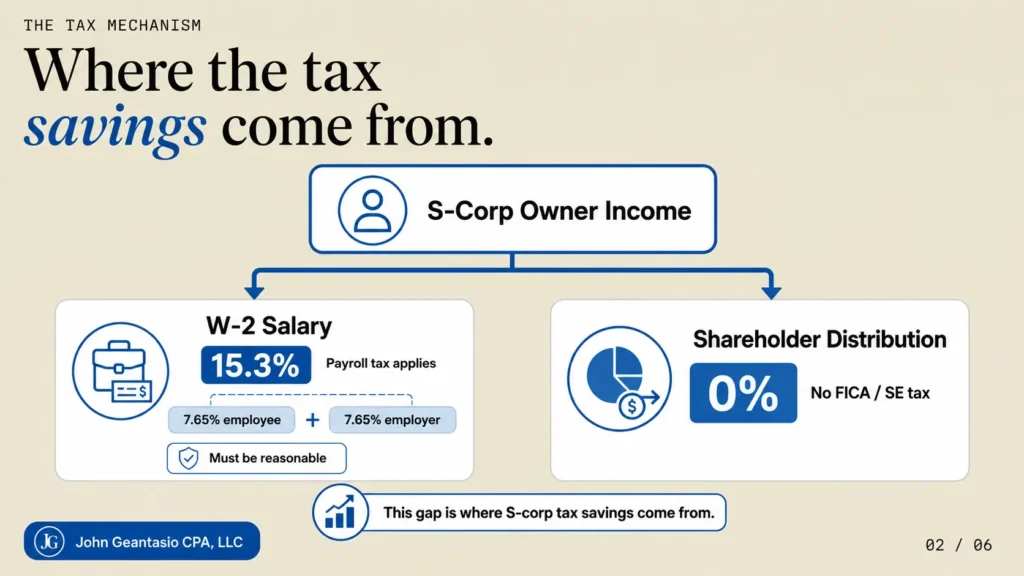
If you run your business as a sole proprietorship or a single-member LLC that hasn’t elected S-corp treatment, every dollar of net profit is subject to self-employment (SE) tax: 15.3% — 12.4% for Social Security up to the 2026 wage base of $184,500, plus 2.9% for Medicare with no cap (IRS; Social Security Administration). At $120,000 of net profit, that’s roughly $16,955 in SE tax alone, calculated on 92.35% of net earnings.
Elect S-corp treatment and the math splits in two. You must pay yourself a reasonable salary as a W-2 employee, and that salary is subject to the same 15.3% — split as 7.65% withheld from your paycheck and 7.65% paid by the corporation as employer. But anything paid out beyond that salary as a shareholder distribution is not subject to SE tax or FICA at all. That gap — full payroll tax on salary, zero payroll tax on distributions — is the entire mechanism. It’s not a loophole; it’s how Congress wrote Subchapter S, and the IRS’s only real check on it is requiring that the salary be genuinely reasonable for the work performed.
If your income is high enough that an additional 0.9% Medicare surtax applies (wages or SE income above $200,000 single / $250,000 married filing jointly), that surtax applies to both salary and net SE income identically — it doesn’t change the S-corp math, it just adds to the baseline.
How much of my income actually has to be salary?
This is the piece that determines whether the election is worth anything, and it’s also the piece the IRS scrutinizes hardest. “Reasonable compensation” generally means what you’d have to pay someone else to do your job — informed by your role, your industry, your hours, and comparable wage data, not a flat percentage. As a rough starting range, many practitioners set salary somewhere between 30% and 50% of net business income for an actively-working owner, then adjust up or down based on the actual duties performed. Set it too low relative to the work you do, and you’re exposed to the IRS recharacterizing distributions as wages — plus back payroll tax, penalties, and interest. We cover exactly how we build a defensible number, with the documentation to back it up, in how we set a defensible reasonable S-corp salary for a NJ owner— worth reading before you file the election, not after.
One thing a lower salary does not do for free: it shrinks your Qualified Business Income (QBI) deduction pool at the same time, because your salary is deducted from business income before QBI is calculated. Below the 2026 QBI phase-out thresholds ($201,750 single / $403,500 married filing jointly, per IRS Rev. Proc. 2025-32), a lower reasonable salary usually helps you on both fronts — less FICA and more QBI. Above those thresholds, the calculus flips in one respect: your QBI deduction becomes capped by 50% of W-2 wages paid (or 25% of wages plus 2.5% of qualified property basis, if greater), so an artificially low salary can shrink the deduction ceiling right when you need it most. If you’re a higher earner, the salary number isn’t just an SE-tax decision — it’s a QBI decision too, and the two pull in different directions once you cross the threshold.
What does an S-Corp actually cost to run that a sole proprietorship doesn’t?
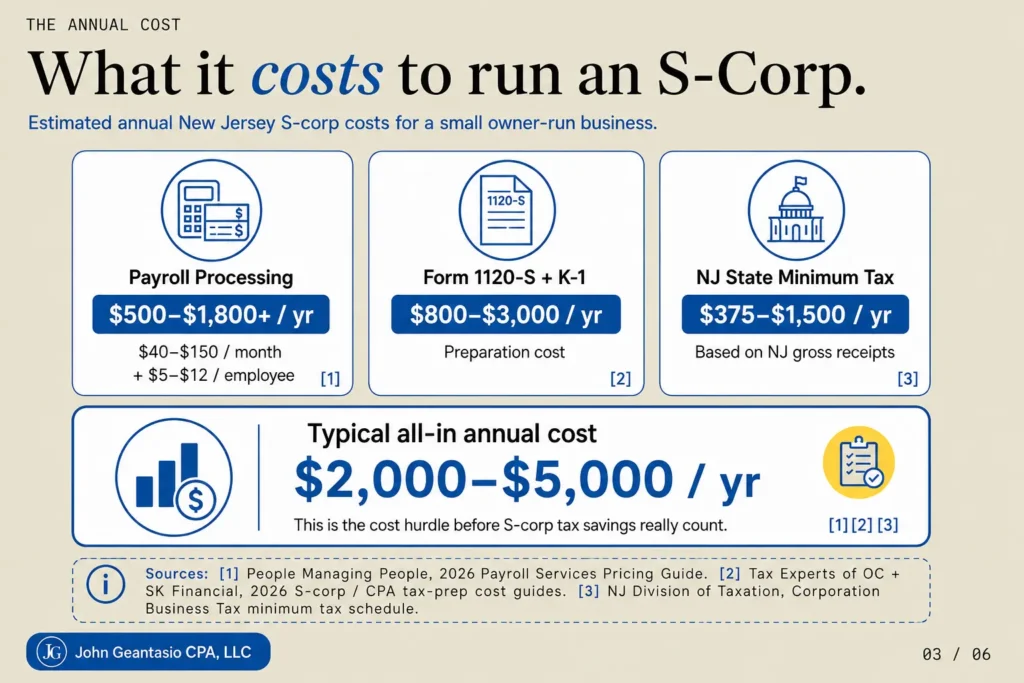
This is the part general “S-corp saves you money” content skips, and it’s the reason the break-even point isn’t zero. Running payroll and a separate corporate return adds real, recurring costs:
- Payroll processing: a base fee of roughly $40–$150 a month plus $5–$12 per employee, or a low three figures a year for a single shareholder-employee running payroll through a service built for exactly that (2026 payroll-services pricing guides; some providers offer a flat annual option near $500 for single-shareroom S-corp payroll).
- A separate business tax return. Form 1120-S plus a Schedule K-1 typically runs $800–$3,000 depending on complexity, on top of whatever your personal return already costs — versus a Schedule C, which is usually priced as an add-on to the individual return, not a standalone return (2026 tax-prep cost surveys).
- New Jersey’s Corporation Business Tax minimum tax. An S corporation must file Form CBT-100S and pay a minimum tax based on New Jersey gross receipts, ranging from $375 to $1,500 a year (rising to $2,000 only for large affiliated groups) — a cost a sole proprietor or a single-member LLC filing as a disregarded entity simply doesn’t have (NJ Division of Taxation).
- Workers’ compensation, in most cases, is not an added cost if you’re the sole shareholder and the only person performing services for the corporation — New Jersey lets a single-officer, single-shareholder S-corp elect out of coverage. The moment you add a second employee or a co-owner performing services, coverage becomes mandatory (NJ Dept. of Labor & Workforce Development).
Add it up and a realistic all-in cost of maintaining the S-corp structure runs roughly $2,000 to $5,000 a year for a small, single-owner business. That’s the number that has to be beaten before the election is worth anything.
So where’s the actual break-even?
Take a Monmouth County service business with $120,000 in net profit. Set a defensible salary of $60,000 and take the remaining $60,000 as a distribution.
- Sole proprietor / no election: SE tax on the full $120,000 ≈ $16,955.
- S-corp: FICA on the $60,000 salary (both halves combined) = 15.3% × $60,000 = $9,180. The $60,000 distribution owes $0 in payroll tax.
- Raw payroll-tax savings: about $7,775.
- Subtract the added cost of running the S-corp (payroll service, the 1120-S, NJ’s minimum tax): roughly $2,000–$5,000.
- Net savings after costs: somewhere between $2,775 and $5,775 in this example — a real number, but a much smaller one than the headline “$7,775 saved” a quick calculator would show you.
Now shrink the example. At $50,000 of net profit, a reasonable salary for real work performed is often $30,000–$35,000 of that — leaving only $15,000–$20,000 in distributions. Payroll-tax savings on that much distribution income run about $2,300–$3,000, which is close to or below the added cost of running the election. Below roughly $40,000 in net profit, there often isn’t enough room between a defensible salary and total profit to generate distributions large enough to clear the added cost — which is exactly why practitioners treat $40,000–$50,000 as the point where the conversation becomes worth having, and $60,000–$80,000-plus as the point where the answer is reliably yes.
Is this an “S-corp vs. LLC” decision?
Not really — and this is where a lot of owners get confused. An LLC is a state legal entity. An S-corp is a federal tax election you can layer on top of an LLC (or a traditional corporation) once it’s formed. You’re not choosing between “having an LLC” and “having an S-corp.” If you already have a single-member LLC, the real decision is whether to keep its default tax treatment (taxed as a sole proprietorship, full SE tax on all profit) or file Form 2553 to have that same LLC taxed as an S-corp for federal purposes — the entity itself doesn’t change.
Timing matters here. To be effective for the current tax year, Form 2553 generally has to be filed within 2 months and 15 days of the start of that tax year — for a calendar-year business, that’s roughly March 15 (IRS instructions to Form 2553). Miss that window and the election takes effect the following year, unless you qualify for late-election relief under Rev. Proc. 2013-30, which the IRS grants for a reasonable-cause failure to file on time, generally within 3 years and 75 days of the intended effective date.
One more piece specific to New Jersey: if your federal S-corp approval letter is dated on or after December 22, 2022, you no longer file a separate New Jersey S-corp election form. New Jersey now recognizes the federal election automatically — but you still have to be properly registered with the NJ Division of Revenue and Enterprise Services as a corporation (“1120 Filer”), and you must submit a Shareholder Jurisdictional Consent along with proof of your federal approval (the IRS’s CP261 or 385C letter) before your first Form CBT-100S is accepted (NJ Division of Taxation, P.L. 2022, c. 133). Older approval letters, dated before that change, still follow the prior process. A number of NJ businesses that elected federal S status years ago never made this connection at the state level and have been taxed as C-corporations in New Jersey without realizing it — worth confirming if your entity has been registered and reconciled correctly.
What should you do next?
The revenue line isn’t a fixed number — it moves with what a defensible salary looks like for the actual work you do, and with how tightly you can run the payroll and filing costs. The way to know where you stand isn’t a rule of thumb; it’s running your actual net profit, a realistic reasonable-salary number for your role, and the real cost of running payroll and a corporate return through the math side by side. That’s what we do in a tax-planning consultation before you file anything.
Book a tax-planning consultation and we’ll run your actual numbers before you file the election.
Sources
- IRS, Self-Employment Tax (Social Security and Medicare Taxes) — https://www.irs.gov/businesses/small-businesses-self-employed/self-employment-tax-social-security-and-medicare-taxes (as of 2026-07-02)
- Social Security Administration, Contribution and Benefit Base (2026 wage base $184,500) — https://www.ssa.gov/oact/cola/cbb.html (as of 2026-07-02)
- IRS, Instructions for Form 2553 — https://www.irs.gov/instructions/i2553 (accessed 2026-07-02)
- IRS, Late Election Relief — https://www.irs.gov/businesses/small-businesses-self-employed/late-election-relief (as of 2026-07-02)
- IRS, Revenue Procedure 2025-32 (2026 inflation adjustments, QBI thresholds) — https://www.irs.gov/pub/irs-drop/rp-25-32.pdf (as of 2026-07-02)
- IRS Newsroom, IRS releases tax inflation adjustments for tax year 2026 — https://www.irs.gov/newsroom/irs-releases-tax-inflation-adjustments-for-tax-year-2026-including-amendments-from-the-one-big-beautiful-bill (as of 2026-07-02)
- IRS, Qualified Business Income Deduction — https://www.irs.gov/newsroom/qualified-business-income-deduction (as of 2026-07-02)
- NJ Division of Taxation, Electing S Corporation Status — https://www.nj.gov/treasury/taxation/br3.shtml (as of 2026-07-02)
- NJ Division of Taxation, P.L. 2022, c. 133, New Jersey S Corporation Procedural Changes (TB-105) — https://www.nj.gov/treasury/taxation/cbt/scorpfaq-proceduralchanges.shtml (as of 2026-07-02)
- NJ Division of Taxation, Corporation Business Tax minimum tax schedule (S-corp $375–$1,500; $2,000 for large affiliated groups) — https://www.nj.gov/treasury/taxation/corp_over.shtml (as of 2026-07-02)
- NJ Dept. of Labor & Workforce Development, Workers’ Compensation Employer Requirements — https://www.nj.gov/labor/workerscompensation/employer-requirements/ (as of 2026-07-02)
- 2026 Payroll Services Pricing Guide, People Managing People — https://peoplemanagingpeople.com/payroll-compensation/payroll-services-pricing/ (as of 2026-07-02)
- S Corp Tax Preparation Cost: Average Fees and Factors (2026), Tax Experts of OC — https://taxexpertsofoc.com/blog/s-corp-tax-preparation-cost (as of 2026-07-02)
- CPA Tax Preparation Cost 2026: Average Fees by Return Type, SK Financial — https://www.skfinancial.com/blog/average-cost-of-tax-preparation-by-cpa (as of 2026-07-02)